
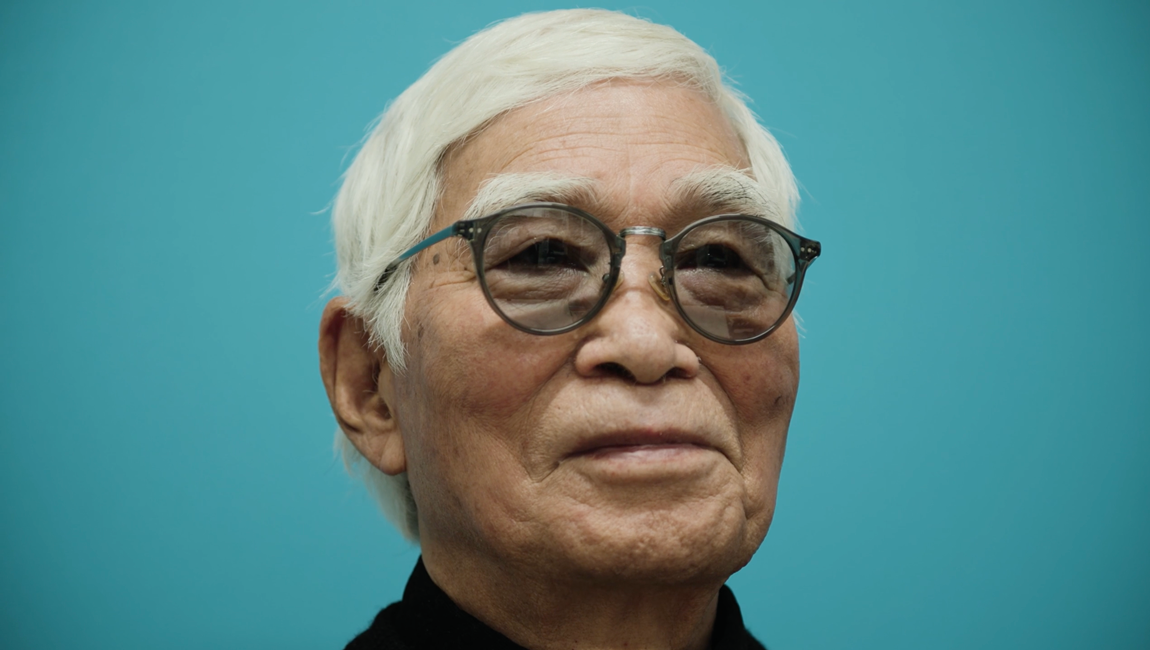
A committed revolutionary who doesn’t see his filmmaking practice as something separate from his revolutionary aims, Masao Adachi has consistently stuck to his guns under utmost duress, refusing even to let what was declared a national tragedy (the assassination of Shinzo Abe) remain unexhumed. Naturally, his revolutionary ideology has a price to pay, and in this case, it resulted in multiple prison sentences abroad for his militant support for Palestinian liberation (a film even sprang from his travels, Red Arm/PFLP – Declaration of World War, co-directed by Pinku film maverick Koji Wakamatsu), and, following his deportation, the withdrawal of his passport by the Japanese government. Flung from one bureaucratic department to another, Adachi’s ordeal in retrieving his passport has only been met with 17 denials. A natural tendency for any filmmaker would be to foreground this struggle, laying out the historical context while rousing their audience through Adachi’s dogged defiance. But for Palestinian filmmaker Kamal Aljafari, such struggles with displacement and dissent are all too familiar. Therefore, he and his collaborators (the project was jointly conceived with Adachi, filmmaker Neo Sora, Ikuyo Shida, Makiko Nishigaito, and Hideo Shida) shift the focus of the film to the seemingly innocuous act of Adachi taking a passport photo himself, baiting both Adachi’s supporters and detractors into expecting an overtly radical revolt based on Adachi’s reputation, while turning their attention to kitsch, both communist and capitalist.
Masao Adachi Takes a Passport Photo indeed shows us the very action of its title, but without a frontal shot of Adachi. Aljafari films him primarily from the back and side, giving us the occasional glimpse of parts of Adachi’s facial profile. The “full picture” of Adachi’s face is only seen in the passport photo, the very denial of that document simultaneously freeing Adachi from the disciplinarian confines of the passport frame while tethering him to Japan. The picture and its accompanying labels (“communist,” “anarchist”) are all that make a dissident, so every “normal” action is imputed to disruptive, revolutionary intent. So Aljafari accordingly doles out parodic communistic kitsch — Che Guevara cigarettes, passport photos framed through garish red filters that recall Warhol’s pop art — for governments who can only conceive of left ideologies in terms of their accouterments and larger-than-life figures. Aljafari spends even more time with the studio owner, a kindly old lady who has some difficulties with the copying machine, than with Adachi, offering the capitalistic kitsch strewn across the photo studio — reality shows playing on the TV, souvenirs, photos of attractive locations across the world as advertisements — as an apt counterpoint, reframing the entire (governmental) discourse on ideology and normalcy through commercial objects. Though he doesn’t cover too much new ground in this regard, the contrasts and Adachi’s tongue-in-cheek retorts are delightfully engaging.
***
Parastoo Anoushahpour’s Peacocks Come With the Clouds also homes in on a mystique — a mystique of a minority community and the mystique of the Western world through their lens. Ostensibly intended to be a documentary on the embroidery in Kurdish villages located on the borders of Iran and Turkmenistan, Peacocks Come With the Clouds is instead an evocation of a strange, surreal mood, a mood wrought by Iranian propaganda and, perhaps, the current war and incessant American attacks. Shrill industrial noises from factories almost induce the villages into a daze, a daze that can’t be dispelled by either getting too close through disorienting handheld footage or zooming out too far through landscape shots teeming with clouds functioning as harbingers of things to come. The title possibly alludes to the mating dances of peacocks as a prelude to the rain, a motif that lines the intricate embroidery the villages are famous for, but as a villager remarks, even the peacock might have been brought by the Russians. Conspiracy wafts through the air, and even the seemingly innocent children are corrupted by it. These children become our entry point into this world of embroidery, with Anoushahpour focusing on children’s workshops while simultaneously depicting their surrounding neighborhoods. By centering the children’s perspective, she attempts to channel the spirit of Kiarostami, subjecting the entire embroidering process and its histories to critique through the lens of a confused generation.
However, her knack for conjuring eerie, extraterrestrial moods overwhelms the agency and art of the villagers, which she rather tackily underlines through sci-fi staged plays of aliens by the children. (Who would have thought that the connective tissue of these two films is actually… kitsch?) The embroidery is more often than not reduced to a prop, one that serves to enhance the film’s moods, almost as if the art form itself is in a state of crisis. Perhaps this is the point Anoushanpour wishes to make at this particularly fragile juncture in Iranian and Kurdish history, but this also robs the villagers of their culture and specificities, making them mere pawns in the hands of larger historical and political forces. The art form isn’t given its due, nor is there a sustained critique of it, so all that remains is its death knell, which regrettably makes this film an act of cynicism rather than one of resistance.
Published as part of TIFF 2026 — Dispatch 5.
Comments are closed.