
The post-Drive My Car films of Ryûsuke Hamaguchi have built a case for the director as the most acclaimed contemporary filmmaker in the world. Even more than his Japanese colleagues, like Kiyoshi Kurosawa or Sho Miyake, who have been educated or critically appreciated by the influential critic Shiguéhiko Hasumi, Hamaguchi seems able to pivot his approachable style toward societal disasters that somehow never spell the total end of the world, and the way filmmaking can fill that void of meaning. While comparisons to Rivette are now more scarce in his career, a generous reading would suggest his theatrical interests can be similarly keyed as rehearsals for navigating a world of conspiracies. He is unafraid, at the very least, to make films that address our current moment, or at least a version of that “moment” that corresponds to the potential space afforded at Cannes or the fall festivals.
The incursion of resource extraction and development in Evil Does Not Exist is, in a less harrowing but perhaps even more disquieting way, brought forth in his new film, which sets the fading memory and physical ability of French seniors with dementia next to the highly regimented, boundary-porous labor performed by the administration and nursing staff at an elderly care facility. Hamaguchi is, once again, using a large canvas to detail a continuum of emotional devastation that is punctuated by dramatic interventions via dialogue and theatrical performance. All of a Sudden is both very easy to take in — it is a picturesque and patient time at the movies — and a work stretched to a breaking point. This is a film about how medical patients and workers alike are exploited for financial gain, and what this does to one’s capacity for thought in work and life; it is also a film that showcases Hamaguchi’s ability to slip into the mode of the French tradition of quality without missing a beat. In some respects, it is a return to the core dynamic of Drive My Car, an expansion of its ethos, and an endpoint stylistically and structurally that seems impossible to push further.
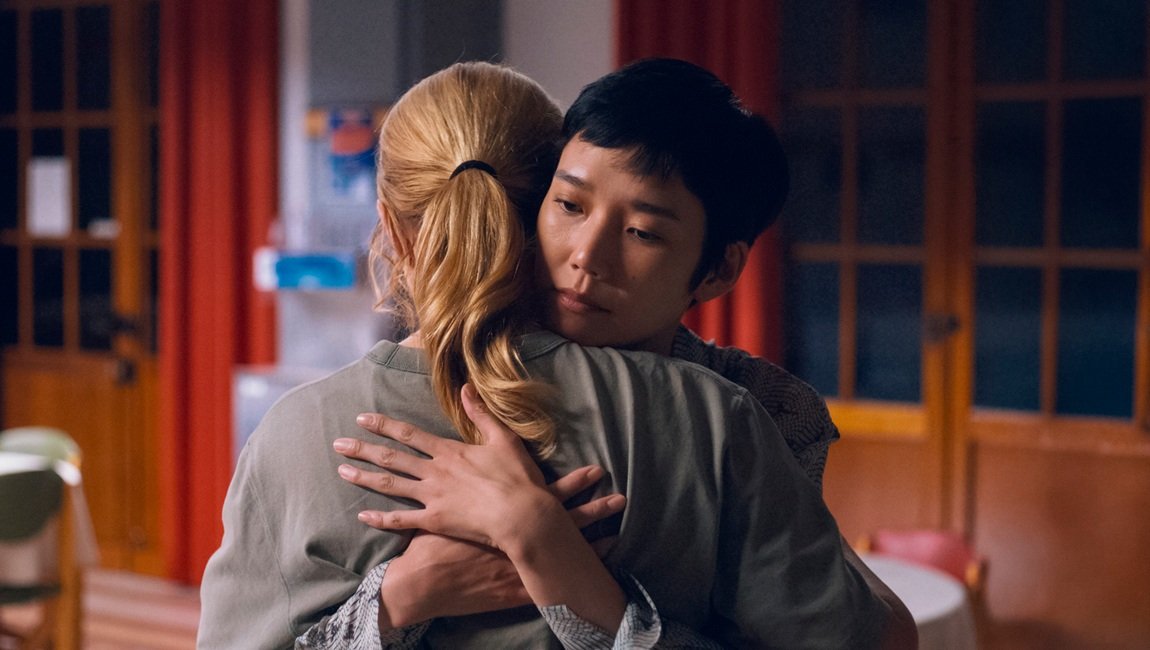
Familiarity is one of the driving forces of meaning in the film. Marie-Lou (Virginie Efira) is the director of a nursing home. She meets Mari (Tao Okamoto), a theatre director. Hamaguchi has based their long, searching dialogues on an epistolary non-fiction text between two similar women; however, their professions have been brought more in line with his interests. In the book, they are an anthropologist and a philosopher; here those professions have been shuffled into their backstories. Similar names, shared languages, and an echoed tolerance for late-hours inquiry and safely restorative intimacy link them together and, in the film’s final act, emanate outward into the nursing home staff, at least those who have seen Mari’s play or have a similar personality to Marie-Lou.
Hamaguchi faces a challenge as Marie-Lou and Mari spend more time together. The principle of possibly his greatest film, Happy Hour, is that its four protagonists each demand a full account of their social life. In order to accommodate their work and family, along with the overlapping instances where the quartet’s interpersonal worlds connect, the film is over five hours long. Something similar occurs in All of a Sudden, but once one of the characters reveals a terminal cancer diagnosis, the film is set on a trajectory that can only end in cathartic understanding. This strict and classically constructed path through all the mysterious and hard-to-assimilate details that Marie-Lou and Mari exchange is also, notably, cluttered with halting introductions to tertiary characters.
In a sequence that brings the film to a spectacular standstill, Mari presents to Marie-Lou her understanding of global capitalist resource-extraction as a way of understanding her own ability to practice art, and even to connect (or not) with Mari as a friend. It’s the culmination of an extremely extended sequence, one that relies on Hamaguchi’s trademark ability to sustain high-attention dialogues between characters. These scenarios in his films often hold no particular promise of highly charged events, yet they retain a privileged narrative position, such that one could say that Hamaguchi’s way of conceiving character in these moments installs these characters as directors of potential drama. (Here, of course, this idea is explicit by nature of job titles.)
So what happens when Hamaguchi must re-introduce this duo to the wider world? If capitalism’s ability to leech social bonds into merely social appearances is now an activated piece of knowledge for these self-aware characters, how will we see their future interactions play out? This private dialogue is interrupted by the sudden appearance of Djibril, a nurse who works under Marie-Lou. Not only is this comic timing a way of alienating Djibril from joining in the scene, it points to a tendency elsewhere in the film, to only halfway develop character traits for the facility’s workers. Despite some appearances, the film does not truly care about Sophie, an experienced and more skeptical nurse who opposes Marie-Lou’s managerial approach, or Adidja, a nurse who, like Marie-Lou, decides to room at the facility, blurring the lines of any work-life balance. The film seems to absolutely assume the perspective of Marie-Lou to the extent that it proliferates the organization’s mandated exercises in which staff members are made to introduce themselves and their personality traits via quirky or heartfelt interviews.
This dynamic also correlates to Hamaguchi’s adaptation strategy. At the film’s outset, Marie-Lou is near burnout due to underfunding and low staff buy-in to a new training initiative, while Mari works hard to ensure her theatrical production remains only a single actor with a minimal set. After their rejuvenating first meeting, Marie-Lou’s workplace successfully hits new benchmarks, and no one has anything other than the highest praise for Mari’s play. We are a far distance from the theatrical critique scene from Asako I & II. The ideas here — about the presentation of disability and human frailty — are not in need of any fierce counter-examples, but the film does become rather lacking in elements that would position Marie-Lou and Mari within a larger world. Not only can we see this shape as a simplicity of design, but a self-reflexive attitude, wherein Hamaguchi has aligned his movie’s societal suggestions with what his characters possess in terms of intellectual resources. The director and the administrator agree on pretty much everything.
Hamaguchi’s control over reality as a writer and director is proven, after three-plus hours, once again to be a complete triumph — he now makes it look extremely easy. But most of us will have seen enough films that gesture toward a capitalist critique — or in this case, a few strongly articulated misgivings about capitalism — to know that the more streamlined and cathartic a narrative, the less room for consideration remains for the audience. As in the case of the progressive schools, libraries, and city halls of Wiseman’s later films (to which the town hall meeting in Hamaguchi’s Evil Does Not Exist has been compared), we can certainly know after an extended running time what they look like, and the language used to describe them. But unlike Wiseman’s investigations, Hamaguchi’s latest is not so much connected to a monumental shift. The film acts instead as an uncompromised conversation, one with an endpoint that sweeps away troubling ambiguities.
Published as part of NYFF 2026 — Dispatch 4.
Comments are closed.