
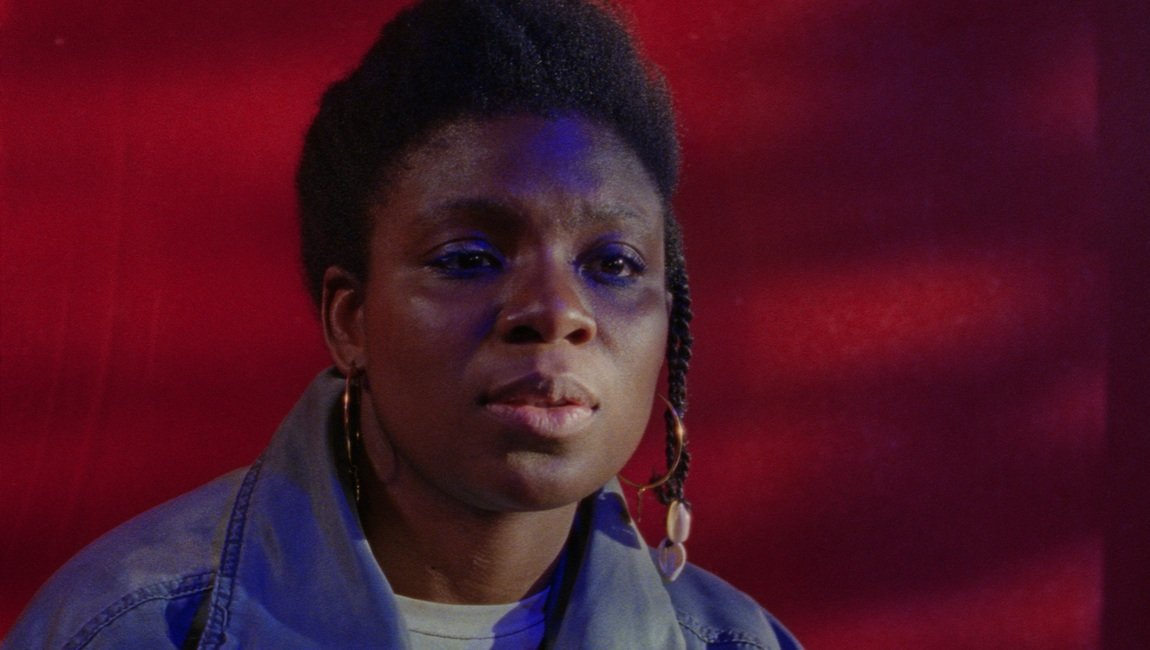
As the title would have us to expect, Beatrice Gibson’s At Night is indeed (mostly) a nocturnal film, but Gibson does so much more than merely shooting the streets of Paris at night. “Night” here not only constitutes the time of the day marked by the absence of sunlight, but also our attitudes to it, the feelings it evokes and invokes in a culture predicated on working through the day, the brief moments of respite it offers from the grueling impositions of daily life, and maybe, just maybe, the fleeting opportunities for freedoms and reflections that are normally curtailed by the norms of the day. Opening with a quote from Alice Notley’s poem — itself famous for its extravagant use of quotation marks breaking each verb, let alone phrases — where each word appears one by one on a black screen, almost cadenced to the background sounds of dripping droplets (or the blinking of an eye), At Night is a film situated in the space between sleep and wakefulness, where people slide in and out of personas, shift between multiple states of being, drift from one encounter to another, floating along the bright, fluorescent night lights of sleepy Parisian streets to the steady, calm hums of cars, metros, night buses, and shutters of shops closing. The darkened skies and hums lull one to sleep, while thoughts and memories stifled during the day awaken, transporting us from one surreally charged location to another that sustains the liminality of the hour and state of mind.
In this seemingly free-floating world, the notions of character and narrative no longer hold sway, but this doesn’t necessarily imply an absence of the political or a breakdown of societal structures. In fact, the night almost emerges as a time of reflection and resistance precisely because we are strangled by the strictures of the day. (There are complications for those who work at night, and that perhaps is a subject for a different film, but as films such as Bette Gordon’s Variety [1983] and Marie-Claude Treilhou’s Simone Barbes or Virtue [1980] testify, the atmosphere is starkly different from the daytime grind.) At Night is mostly peopled by women, and this lends the film’s shots a particular poignancy, allowing the women navigating a patriarchal world some much-needed time for their thoughts and reflections. Gibson follows seven women specifically, most of whom aren’t even given a name, and even the ones who are are thrust into different spaces and conversations to the extent that any information gleaned from one context almost morphs into something different in another. Settings, scenarios, and conversations lead to multiple modes of expression, recontextualizing seemingly recognizable character traits into something more exploratory and expansive. Femininity itself is in a state of flux, challenged by class, race, gender-fluidity (queer musician Adam Christensen, whose “femininity” contrasts with the normative framework), and even work, with each of the performers relating to sexuality, motherhood, and material realities through their expanding perspectives.
Alice Notley’s verse (“I am a tone of voice. Warming, shifting, pausing, changing, including, asserting, exulting, including, including, turning and including.”) marks not only the beginning of the film, but its operating principle, especially in its rhythmic, almost incantatory, repetition of the word “including.” Gibson includes a diversity of perspectives not to lump all females into one basket, but to push forth a feminism that foregrounds heterogeneity. Stark inequalities exist amongst the women themselves, and these end up structuring their encounters. A filmmaker played by Gibson herself is only able to meet her former household help (the only character with a name, Didi) in a department store whose owner shuts off the lights and closes the shutters the moment they cross each other’s path. Any attempts by the filmmaker to “equalize” the power dynamics and privileges governing their relationships by staging meetings in public spaces (bars, stores, metros and buses) are thwarted by the internal dream logic of the film itself, laying bare the fiction behind the documentary depictions of the Parisian streets and details from the performers’ lives. In the conversation that ensues, Didi confronts both the filmmaker’s privilege and guilt over it, targeting her critique toward the system as a whole. When the conversation ends, we see the morning light for the first time.
The centerpiece, which is slightly underwhelming compared to the rest of the film, involves six of these performers, discussing their attitudes toward sex and motherhood, informed by their experiences and perspectives. Gibson’s camera tightly films each of them, allowing room for no other person in the frame barring reflections of these women themselves (aptly, reflections on windows are a common visual motif). Their conversations are more reflective of the discussions emerging from ‘70s and ‘80s feminism, and while some of their ideas on power, sex, and nuclear families are interesting and even radical, they often register as throwaway lines that are rather underexplored. The film’s radicality, both aesthetically and politically, lies, however, more in Gibson’s embodiment of nighttime’s liminality than in these conversations, where she uses the ambulatory moods of the night as a guiding ethos for feminism itself. In a world which rigidly defines and delimits the behavior and actions of women, restiveness emerges as a form of resistance. Gibson’s triumph is to ensure that this restiveness, however loose and open, isn’t directionless, combining a defiant refusal to be tied down with a clarity on what needs to be done for a better future.
Published as part of NYFF 2026 — Dispatch 7.
Comments are closed.