
Having seen all six Currents shorts programs at this year’s New York Film Festival, Program 3: Surface Noise emerged as the most successful of the groupings. The six filmmakers (and one painter) featured in it all generally had a better handle on what they were aiming for; all the films were legitimately experimental, and even the entries that didn’t always work were at least respectable programming decisions. Starting with the least successful film, even Laura Kraning’s Interwoven Intervals had clear merit and was a justifiable inclusion. An exercise in laser printing black-and-white geometric patterns onto transparent 16mm film leader, the soundtrack is the sound of patterns as they pass through the sound head and are read optically. It’s hardly the first optical soundtrack film, but those are usually enjoyable for at least part of their running time as you get to see what patterns the filmmaker has come up with, or if they’re capable of turning the noises into a new kind of music. Interwoven Intervals’ patterns are pleasurable to look at for a stretch, but it struggles when it tries to expand to a larger scope and begins embracing the digital side. Kraning incorporates outside music that doesn’t serve the project, and begins dividing up the screen so that we see the same visuals in photonegative form — none of these effects really bring out anything new, and you start to realize how few variations there ultimately were. By the time the screen is like nine squares of a chessboard, all showing the same visuals as either black on white or white on black, the film starts to feel like it’s played itself out, but it at least got off to a good start.
Monochromatic visuals also play a role in two of the three titles that were shown on celluloid prints, but said pair is otherwise that of complete opposites. Siegfried A. Fruhauf’s Flim Flam was shown on 35mm and is a rather bombastic sound film, while Karissa Hahn’s Moored Shadow was shown on 16mm and was totally silent. Hahn’s film was by far the shortest film in the program at only four minutes, but by her standards, that’s an epic: her running times are almost always single-digit numbers, if not less than a minute. Like most microshorts, its pleasures have to be modest, but in this film they’re real: a series of whip-pans and readjustments that turn a sunny woodland into a place where something surprising seems to pop out when the blurs settle down for a bit. Fruhauf’s film, meanwhile, is perhaps the hardest to assess, and it’s also likely the hardest to watch. The strobing effects involving horizontal stripes and exclamation points that go from black to white and back again, all in fractions of a second, are positively eye-searing. (There are also color portions that are relatively less assaultive.) The numerous visuals related to zebras are definitely a thematic throughline of sorts, but whether the film totally coheres, or is just a series of optical illusion set pieces on a Tony Conrad theme, would probably require a second look and some more investigation into Fruhauf’s body of work to totally determine. One could argue that the title referring to a piece of deception means that a sense of things not cohering after your eyes have been assaulted is part of the joke, which would be a legitimately innovative trick to pull.
Simon Liu’s Procedures kicked off the program, and this was a strong sequencing choice. It feels the most accessible of the group, both in the sense that it’s a typical Liu film and that his style is the easiest to appreciate for its surface pleasures. By this point, it can be a bit hard to tell apart the variations between Liu’s various deconstructions of Hong Kong, but his visions of the city are like no one else’s: bright colors, nonstop superimpositions, loud sound design, and plenty of mixed media bombast. Procedures will likely be remembered as “the one with the eggs” in subsequent Liu retrospectives, and the sheer abundance of them throughout this movie has a charming drollness to it, even if one can’t entirely explain why it’s funny. For an overt joke, simply keep an eye out for a sequence involving a little girl watching a television show. It’s not as thrilling as Devil’s Peak (2022), but there’s plenty to enjoy.
Ultimately, the program’s second film and its finale made the most immediately compelling cases for what experimental film could do to reinvigorate the medium. Even with the many rewards earlier in the program, sometimes one wants an experimental film to really provoke, and Cameron Worden has once again made a 35mm film that both serves as a wild closer and makes other filmmakers look timid. Day One’s title winds up suggesting the possible nightmare a projectionist might have of a potential first day on the job, or perhaps a primordial origin point for celluloid. (Worden is an experienced projectionist who frequently works with 35mm slide projectors — he stated in the Q&A that as long as images are visible and sound is audible, Day One is being properly projected.) An entirely photochemically-produced work seemingly inspired by Paul Sharits’ quote about “[giving] up imitation and illusion and [entering] the higher drama of celluloid, two-dimensional film stripes, individual images, nature of perforation and emulsion, [and] projector operations,” Day One’s visuals are only summarizable in the sense that colors, shapes, frame lines, and scratches are easy enough to conjure up in the mind’s eye. The approach is mostly closer to a slow and gradual bleed from one visual to another rather than single-frame flicker, but there are certainly exceptions. The soundtrack is the real thrill: the sound of prints going wrong in full stereo, also generated photochemically. After the film’s conclusion, faced with an audience that looked actively drained from the experience of listening to the projector’s subconscious for 16 minutes, Worden cheerfully talked about how the film took inspiration from epic poetry. If all experimental films aspire to poetry, then perhaps that makes Day One a testament to the superhuman forces of celluloid creation and its emergence from the primordial ooze of chemicals that make up what we see on screen.
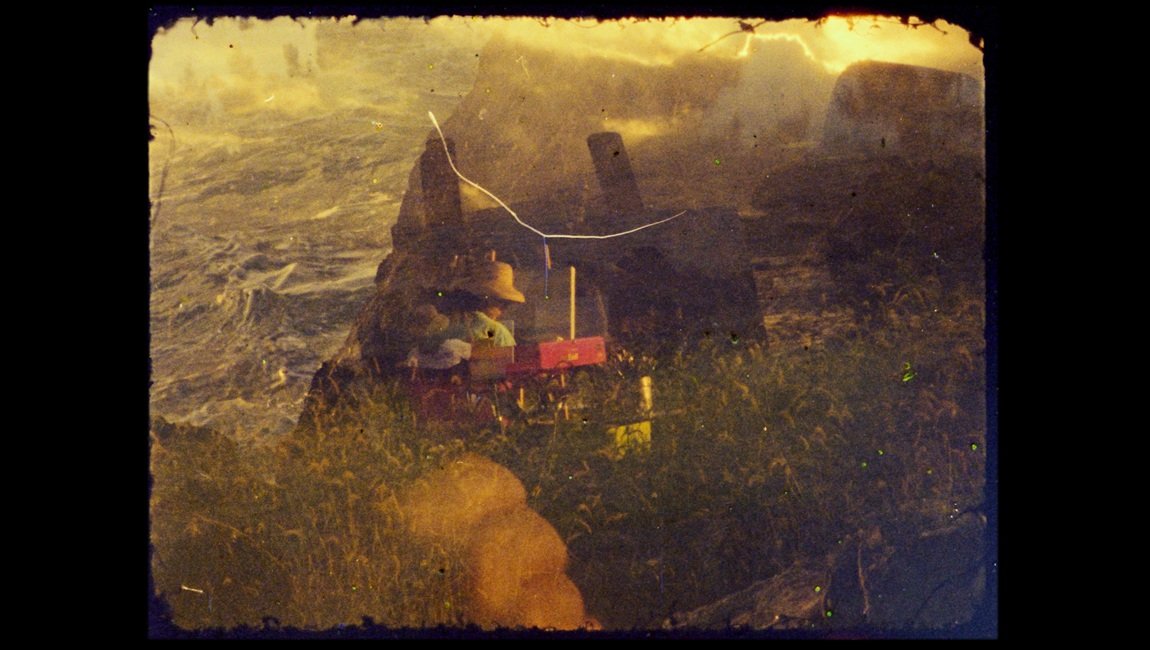
The second film, and the likely highlight of all 20-something Currents shorts, was Jonathan Seungjoon Lee’s Practice Towards Light, a collaboration with the painter Yun-hee Huh. (The exact number of shorts is hard to settle on due to a few older titles being mixed with the new, but the only other contender for best of the 2026 bunch was in Program 2, with Johann Lurf’s musical timelapse astonishment Forever…Forever.) The film had already been made available for a time to online viewers as part of an online program entitled Repeat as Necessary, and while it may have set the bar too high for the films that one saw at NYFF, it wound up serving as a terrific advertisement for attending this particular Currents program. A silent film shot on 16mm, Practice is a portrait of Huh performing her daily ritual of plein air painting the sunrise as it rises above the waters of her hometown. Seungjoon Lee, who shot four rolls of film across each of the four seasons and used each roll seven times to create superimpositions, wound up making a portrait film that seems to fuse everything it’s capturing into one single movement. Huh frequently appears to be painting the real waves and sunsets into motion, while the various colors of the waves and sunsets bleed effortlessly into one another with maximum sensuousness. Superimpositions in experimental film are predominantly associated with Jerome Hiler, but his work tends to have a bit of sprawl rather than the single-minded focus that both Seungjoon Lee and Huh are achieving in the fusion of their respective artistic practices. The silence is that of bliss, and that’s the sensation the film inspires. Portrait films rarely achieve their goals so ideally.
Published as part of NYFF 2026 — Dispatch 7.
Comments are closed.