
Renny Harlin has no competition. That he has managed to corner the market on a genre-diverse yet highly specific form of popular filmmaking is somewhat troubling, considering the mid-to-low budget schlock picture was still an economical enterprise only a decade ago. Nevertheless, AMC-goers are lucky to have him. What directors such as Robert Florey, William Beaudine, and John Brahm supplied audiences in the ‘40s is what Harlin works to maintain in the 21st century: a quick-witted and formally distinct genre cinema, uninterested in the realm of the critics and upper-class audiences, uninterested in anything other than itself.
Case in point: though one should hesistate from calling Harlin’s earlier film of this year, Deep Water, a “good film,” one is struck, waiting for the movie to begin, the barrage of trailers for Obsession, Evil Dead: Burn, Masters of the Universe all blending into a milquetoast cocktail of defeated images, by the gulf between those future releases and Harlin’s work. Deep Water is bloated and awkward, made more so by a set of actors that were clearly never in the same room with each other, but Harlin is able to navigate the successes and failures of such studio-mandated work with ease. He gradually directs focus from character drama, even action, to the textural qualities of water, light, and stars. Aaron Eckart’s race to save plane passengers from bloodthirsty sharks becomes tertiary, like a radio program wafting distantly in a high summer breeze. Harlin switches focus to another detail of the spectacle, letting the script fall where it may.
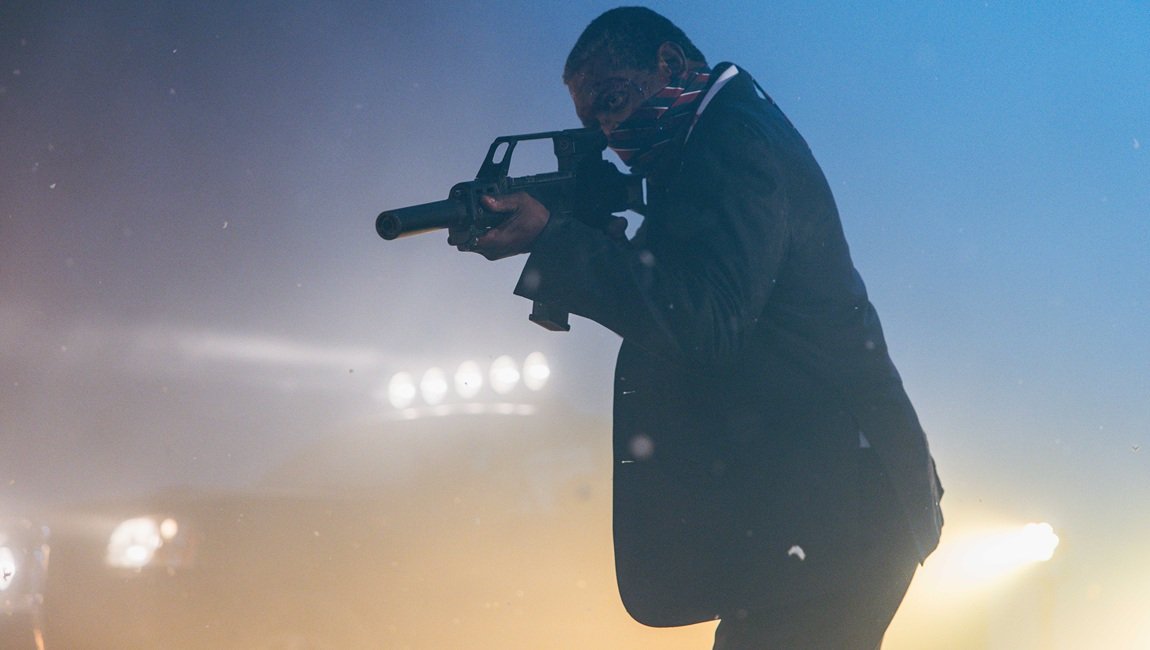
Unlike with Deep Water, there is no difficulty in calling The Beast a fine movie. The scenario is exemplary Harlinian fodder: America is laid siege by a mysterious, global terrorist organization. Their identity is unknown, as are their intentions and power. Death tolls ramp into the thousands. All the while, the President (Samuel L. Jackson) and an injured member of his security detail (Joel Kinnaman) roam around an apocalyptic D.C. in a high-tech escort car. The film, aside from two climactic action sequences, never leaves the futuristic limousine. Echoes of Steven Knight’s Locke, shot with the same conceit, are inevitable, but unfounded; Harlin has no delusions about the quality of the script. The director instead places great care in the volleying of space: the sleek, armored safety of the interior versus the rugged oranges and greens outside. Harlin shoots in wide, probing drones both inside and out, and action is shed down to its most primary concern: territorial encroachment.
No one knows anything about these shadowy figures. The script teases certain revelations, but more frequently further occludes information, allowing the ubiquity of the enemy to serve as explanation enough. Thus, the drama turns to one of discretion, the rapid fixing and unfixing of the eyes as Jackson must devise an escape route in a disintegrating geography. There are no longing shots of a crumbling White House or Lincoln Memorial. Harlin’s D.C. is instead woefully bereft of landmarks. Gothic fogs explode across the demolished Capitol Hill; one would assume the city is only cross sections and strip malls, coated in transnational menace. Jackson scans his opponents’ faces, seems to arbitrarily fix on one of their ranks (Guy Burnet), but is significance is unknown, a desperate attempt to wrench reason from this hellscape of ambiguity. Similarly, Harlin’s camera attempts to construct new signifiers from the emaciated narrative. He delights in the expansion of the visual field — infrared, heat sensors, LIDR — to pierce through the haziness of the naked eye. Still, these systems fail. The fog deepens in black screens and red zones, while the brutality grows more concise.
The real achievement of The Beast (and Harlin’s oeuvre in general) is how the audience is inculcated in his games of sight. In all the films advertised before my screening of Deep Water, though there may be interesting compositions riddled through the runtime, it was always from the perspective of a museum piece, propped up high in the hallowed halls of the modern cinema, while the audience is kept way out of spitting distance. There is no attempt to elaborate the moviegoer’s gaze with that of the camera. More “disposable” works like Harlin’s revel in this process. In cynical terms, to “elevate” the work into an invaluable cultural object would be to compromise its designation as a product. However, such designations keep the artist level with his audience; their gazes become synonymous with that of the director’s. As paramilitary ops descend like cloaked ghosts between alleyways, intersections, and cracked facades, Harlin’s obsessions with lighting become essential, both to characters and audience. Just like Jackson, you squint, glare cockeyed into a troubling darkness, waiting for that glimmer of understanding that will never arrive.
DIRECTOR: Renny Harlin; CAST: Samuel L. Jackson, Joel Kinnaman, Guy Burnet, Eoin Macken, Colin Morgan; DISTRIBUTOR: Aura Entertainment; IN THEATERS: October 9; RUNTIME: 1 hr. 39 min.
Comments are closed.