
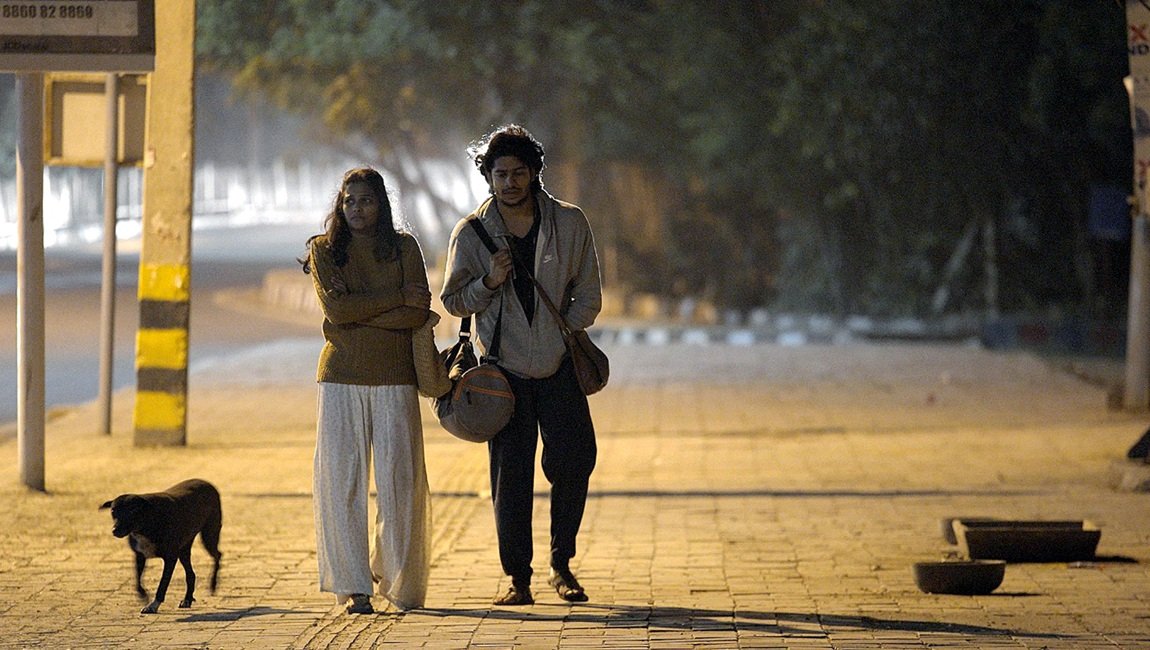
The international breakthrough of All We Imagine as Light in 2024, which was the first Indian film to play in Cannes competition in 30 years, could be taken as a sign of life for, or at least an indicator of, renewed Western attention toward a resurgent parallel cinema in India. Director Payal Kapadia’s executive producer credit on Sanju Surendran’s If on a Winter’s Night signals a kinship between the film and Kapadia’s cinema that bears out on screen. Like Kapadia’s film, Surendran’s movie is a low-key, realistic portrait of life in one of India’s cities that turns its eye toward everyday characters and resists the bombast and melodrama of mass entertainment. While it trades much of the swoony, romantic style of Light for a more quotidian aesthetic approach, it’s easy to see what Kapadia finds compelling about Surendran’s film.
Despite taking its English title from the Italo Calvino novel, If on a Winter’s Night has nothing to do with postmodern fiction and has no structural or metafictional tricks up its sleeve. The title instead refers literally to a crucial winter’s night late in the film that serves as a stress test for its central relationship between Sarah (Bhanu Priyamvada), a film festival employee and aspiring researcher, and her art student boyfriend Abhi (Roshan Abdul Rahoof). The couple, originally from Kerala, has come to Delhi in search of the city’s opportunities. Here they live on little money — only Sarah has an income — and maintain an extremely small social circle. Abhi especially is isolated in Delhi since he does not speak Hindi. The two struggle to get by and stay together as financial tensions and Sarah’s obligations to her family back home mount.
Surendran’s film is impressively all of one piece as every thread emphasizes the intersection of love and money. Watching Sarah and Abhi’s relationship fray throughout the course of the movie over an unreturned loan she gave him and the increasingly dramatic consequences of that lost income is a pointed narrative center, while subplots — like their unhoused friend Simon’s lying to his long-distance girlfriend over video calls — bolster the film’s thematic argument. Elsewhere, Surendran takes time to explore the poorer communities around Delhi, contrasting the displayed visions of communal joy with the disdain of Sarah and Abhi’s landlord, the closest thing the film has to a villain and its most direct representation of a capitalist spectre. As the film goes on, it skillfully piles on incidents rapidly to convey the suffocating frustration of Sarah’s position, each new happening an anxiety inducing knife twist.
That the film’s cohesion and accumulated affect don’t come off as overbearing despite their relentlessness is credit to Surendran’s unshowy approach and the actors’ well-calibrated performances. It’s easy to imagine a bad version of If on a Winter’s Night that leans into sentimentality and melodrama, filled with scene-stealing hysterics and overlaid with a treacly score. But if the impulse toward such a film exists, Surendran has resisted it in favor of a subdued, natural direction which comes with its own pitfalls. Some sections, especially those early on, don’t leave much of an impression, and while the exterior photography is often beautiful — and the clearest link the film has with All We Imagine As Light — the drab interiors are just ugly. And despite the intense focus on class, the film’s analysis never gets anywhere particularly nuanced or revelatory, even as it remains broadly affecting and emotionally true. Like much of If on a Winter’s Night, it works even if it’s a little too simple.
Published as part of New Directors/New Films 2026 — Dispatch 2.
Comments are closed.