
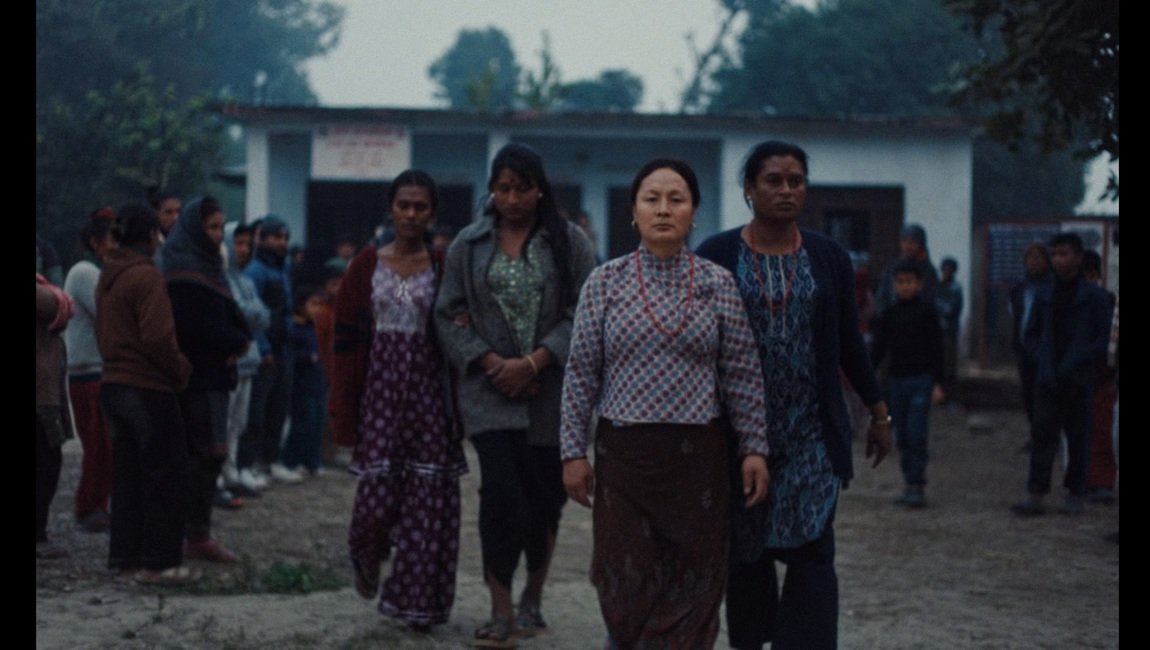
The pressure of representation weighs heavily on Abinash Bikram Shah’s Elephants in the Fog. With its accessible arthouse style and the sobriety of its subject matter, it’s a movie transparently angling for the acceptance of an international audience, and its well-received Cannes premiere earlier this year indicates that, in this regard, it’s a success. Nepali cinema seldom earns this kind of global attention, and movies featuring trans actors in leading roles remain dispiritingly few; the combination of modest style, progressive politics, and an unchallenging portrait of a lesser-known corner of the world in cinema both shines a light on the trans Nepali community and, perhaps, does it a disservice.
Pirati (Pushpa Thing Lama) is a matriarch in a village of Kinnar women in rural Nepal, bordering a forest inhabited by elephants, rarely seen but frequently feared. When Aspara (Aliz Ghimire), one of her adopted daughters, goes missing, Pirati’s search uncovers secrets in both women’s lives, forcing interactions between the Kinnars and the largely hostile locals in the nearby town. Shah acknowledges the reality of living in a society that denies your existence — the women seek truth and justice, yet generally suffer only injustice — without victimizing his subjects, affording them agency and stressing their resilience. Times may be tough, but these women are tougher.
The film’s juxtaposition of thriller elements and the ethnography-lite setting is pretty smooth, with Shah’s quasi-classical approach serving it well. That approach is solid and sensitive, and basically unassailable — he knows who to shoot and how, leaves no loose ends, and there are no questionable edits or music cues. Indeed, everything is so smooth that one soon begins to crave a little edge. Elephants in the Fog is a movie without risk or roughness, or indeed any identifiable directorial signature, and the palatability of it all feels particularly milquetoast considering the conflict inherent to the plot and scenario. Great trans cinema, or even great cinema focusing on any marginalized demographic, is often defined by its subversion, its protesting nature, its fundamental, innate non-conformity. The tastefulness of Elephants in the Fog thus seems relatively conciliatory, a concession made in pursuit of exposure.
Yet, accepting the legitimacy of Shah’s vision (admittedly a little difficult, given that this is a vision of a queer Asian community apparently intended for cishet Western audiences), it’s hard to fault his handling of it. The thriller contrivances in the plot feel germane to the setting and characters, and each new direction illuminates something genuine — there’s a faithfulness to reality in every narrative decision that harbors investment. As Pirati’s search for her daughter becomes more desperate and widespread, she must examine the rules by which she’s led her safe but sheltered life until now, and the contradictions she’s indulged in as a means of escape. Indeed, the whole movie is a meditation on escape — from society into cloistered communities, from dogma into indiscretion, from spirituality into practicality, from the burden of responsibility into liberation.
If the final, stirring scene represents the ultimate liberation of escape — from respectability into defiance — its impact is only so great in relief to what has preceded it. Shah preaches a radical approach that he can’t himself adopt. The boldness of the characters’ actions at this moment is thus safely secured within the confines of the screen, a revolt against passive conformity that Shah only shows, never truly endorses. His compliance to the rules of respectable representation has brought welcome attention to people too rarely seen or heard in cinema, and the movie he’s made is undoubtedly effective in telling its story. But it’s an ironic compliance, not echoed by the message of that movie, and so the message sounds merely mumbled when it should have been shouted.
Published as part of TIFF 2026 — Dispatch 1.
Comments are closed.