
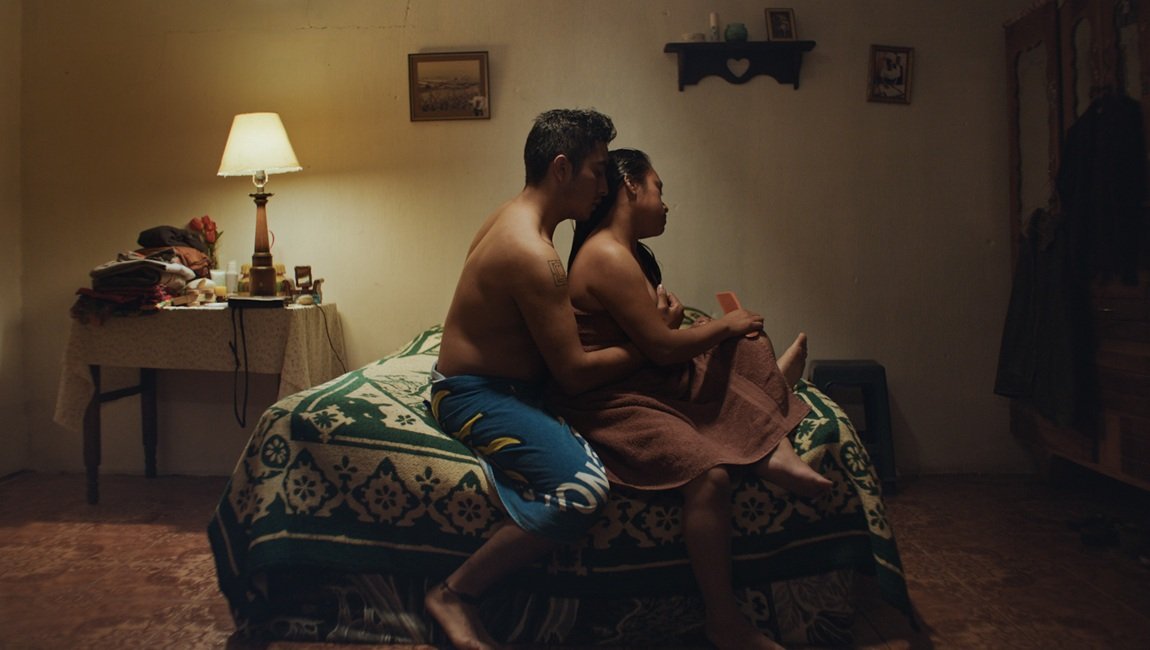
Guatemala on-screen is underrepresented, fertile territory. Mad Mel’s Apocalypto is likely the region’s highest profile depiction, or you could look toward El Norte from Gregory Nava for something a little more grounded — a tale which tells of two children trying to leave the place. But what of the nearly 19 million who stayed and live there to this day? Surely they have stories to tell. Mexican-Guatemalan filmmaker Joaquín Ruano believes so, and his debut film Nosotros offers a moody reprieve from stereotypes about the country, transposing the schema of the doomed queer romance onto Guatemala’s capital. His approach deepens the richness of the setting in our minds, if not the formulaic romance for which it serves as a backdrop.
Romero is an indigenous Guatemalan who leaves his village for Guatemala City to support his wife and child financially. He finds a job as a security guard at a mall, only to fall in love with the owner of a cellphone store there, Nubia. Nubia is a trans woman, but Ruano wisely doesn’t make her identity a focal point of the drama — it’s just a fact of her existence. Instead, Romero and Nubia share delicate moments together in cars and motel rooms, waxing about the nature of community and finding consolation in the warmth of the other’s arms. It’s well-worn territory, and Ruano tries to dodge the story’s more generic qualities by simply leaving most of them out. Ellipses dot the film’s narrative landscape, leaving questions open or left to our preexisting knowledge of the romantic drama’s structure.
Debut filmmakers in the arthouse world have a tendency to be overly studied as of late, their films more curated than created. Ruano is no exception, and his style is deeply referential. He grabs influences from across the globe: Pedro Costa can be found in the street lights streaming through windows to bathe sex workers in sanctity; Bresson in his characters’ stoicism and poise (or maybe Lav Diaz at ludicrous speed, shots lasting “merely” 20-30 seconds); most chiefly, Cuarón by way of Roma in its careful tableaux, framing his subjects within architecture to emphasize their social context. There are worse apples to bite off of, though, and some honest moments emerge from the match between antecedents and milieu. Toward the end of the film, a giant McDonald’s sign towers over a dark road. A car passes by, and Ruano pans over to a giant cross lit up in the night; it captures the collision of traditional faith and fast-paced consumer culture endemic to globalization. It’s a good image, it just has nothing to do with the narrative.
There are a lot of moments that have nothing, or very little, to do with Romeo and Nubia’s plight, and they happen to be the film’s most carefully observed: a group of newly anointed security guards posing with their firearms for a photo taken on an Android phone; a CRTV displaying footage of Romeo wandering the mall’s corridors; a shot gazing out of a windshield on a rainy night as Nubia parks her car and music plays. Ruano appears more interested in the world around his characters than he is in the characters themselves. Moreover, he seems slightly afraid of them. When passion erupts in Nosotros, Ruano’s camera deflects or looks the other way. It’s one thing to defy the cliché of the impulsive and reckless Latin American, but it’s another to shirk away from normal human feeling. At the beginning of the movie, Romeo sits on a bed with his wife Jacina as they hold each other in center frame; later, Romeo makes love to Nubia out of frame — both allude to an urgency Ruano pointedly leaves out of his telling. There’s warmth, but never enough heat to generate a sustainable flame, so once tragedy strikes the film’s central relationship toward the end of the film, it doesn’t bowl us over or upend any expectations set by said relationship; it just happens because the movie gods dictate it.
Nosotros is saddled with many of the frailties first-time auteurist directors must (or rather ought to) contend with. The film communicates some very real and uncomfortable truths about queer and interracial love in 2026 — in a brief aside, Nubia’s employee asks her why she’s into Indians, and Romeo’s co-workers often bully him for what they perceive as a gay relationship — yet they’re undermined by Ruano’s evasive ambiguities and artful sensitivities. Ruano clearly has good taste and an eye for the small pleasures of Guatemalan life, but as yet he can’t cohere these strengths into a satisfying whole.
Published as part of TIFF 2026 — Dispatch 1.
Comments are closed.