
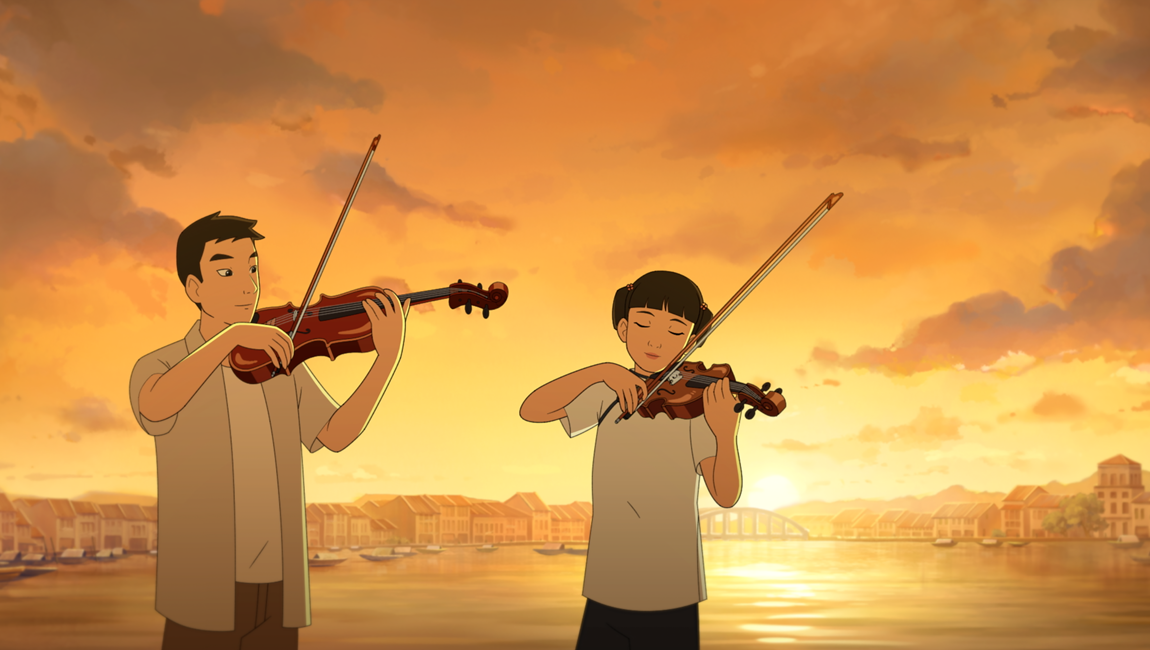
If anyone watches The Violinist, there is a good chance this has something to do with the spotlight thrown upon it by its being awarded the top prize at the Annecy Animation Film Festival earlier this year. The film itself is rather unrewarding. It is not an exemplary work of animation, history, or political artistry, though it can claim a footnote in local animation history, as the first feature to be completed in Singapore in 15 years.
The presence of The Violinist at festivals and, as a long shot, in wider distribution, speaks to the role of the contemporary festival as a distribution and co-production hub rather than an arbiter of artistic vision or aesthetic risk-taking. Because of Singapore’s lack of a consistent funding structure for filmmaking, one could say that this film, directed by Ervin Han and Raúl García, has been tailored solely to make it into festivals, to have the right discourse around it, and certain novelties to append to it in order to sustain a yearlong festival lifespan. But once the deals are done and the laurels have filled the poster, the film itself offers very little to an actual viewer.
There are two figures in The Violinist’s plot who play the violin. Fei is the career performer about to retire who deigns to give an intrepid magazine journalist a retrospective interview in the film’s frame narrative. We might expect a tribute film that traces a life back to an original inspiration, as in Hugo or Millennium Actress. But the other violinist is Kai, a member of the servant class who learns the instrument on the sly and gains an appreciation for the art that has nothing to do with its status in the cultural hierarchy. Their different social standings matter when the Sino-Japanese War breaks out, and each feels a different degree of pressure to engage in or abstain from political activity.
This is a reliably involving premise, and with it comes the ever-relevant question of an artist’s responsibilities. Its ambitious feature-length scope and the fact that the Japanese are the unqualified villains make it rather unusual for an animation project. But the film is schematic and rudimentary in its approach. Unlike past Annecy-praised European co-productions like Flow or Flee, the voice acting and animation work are distractingly substandard, which might be excused if the overall design of the film was of interest in its own right. Instead, the film takes for granted that its Singaporean perspective on WWII is a novelty for an international audience, and relates its chronology with Wikipedia-like distance. What’s more, the script itself is so full of presentist language, aphorisms that arrive with logical errors, and generic summations that, even if LLM assistance wasn’t used in its scripting, it commits the similar fault of being so full of cliché that it renders much of the film — and its attendant political struggles, war orphans, suspenseful bombing raids, and its one miraculously intact violin—as bathetic.
The film’s insistence on classical music as the crux of art and survival is, upon closer examination than Fei’s voiceover narration, also rather dubious. The violin duets that build throughout the film’s opening act are meant to stand in for romance between Fei and Kai — but the way their relationship is rendered stays neatly within the bounds of adopted siblings, which makes Fei’s decades-long loyalty hard to buy as melodrama. Kai’s innate musical prodigy status, which requires zero practice or a hospitable environment, along with a side narrative involving the classical learnedness of a Japanese soldier, also act as an elevated plane of sympathy; the death of all others is vaguely tragic, but the animators treat this attunement to the art form as shorthand for a humanizing trait. Perhaps the starkest punctuation to this focal point arrives in the film’s long denouement, where Fei’s voiceover summarizes post-war anti-colonial struggles in Malaya, Indonesia, and French Indochina as merely a period when “everyone was searching for something elusive.” In this way, The Violist ultimately proves too safe, and perhaps even blithe, about its epic subject matter in a way that short-circuits its potential accomplishments.
Published as part of TIFF 2026 — Dispatch 1.
Comments are closed.