
Toronto-based filmmaker Yuula Benivolski has made several impressive short films, the most recent of which, why I never became a driver, played several experimental film showcases. But those films could not prepare a viewer for the expansive vision Benivolski articulates in her feature debut, The Black Box is Orange. A multi-chapter film essay that explores the filmmaker’s personal and political experiences growing up in Israel, Black Box is uneven, giving the impression that Benivolski wanted to approach this difficult topic from as many angles as possible. It is an imperfect film that has moments of intellectual and artistic perfection, but sometimes gets lost in its own discursive pathways.
But this uncertainty is a fundamental element of Benivolski’s film. It frequently undercuts its own authority by asserting the very specific viewpoint of its maker, and this is crucial. As a Jewish person raised in Israel, Benivolski understands that while she has first-hand experience of Israel’s destruction of Palestinian communities, there are fundamental ways in which this is not entirely her story to tell. By asserting the limitations of her own identity, Benivolski assumes the tone of an expert witness to her own past, in particular her growing fear and rejection of the Zionist project.
This is the type of creative endeavor that must be organized in fragments, to avoid making grand statements on behalf of the often voiceless people of Palestine. Instead, Black Box begins with archival research and material history, as Benivolski tries to reckon with the unease she felt while living in the Israeli border town of Shlomi, which was the Palestinian village of al-Bassa prior to 1948. She describes running through the woods near her house and finding an inexplicable concrete slab in the middle of the trees. She discovers that this was a train platform, that a railway system once connected al-Bassa to Lebanon, and that although much has been done to erase that physical trace of Palestine, reminders still exist.
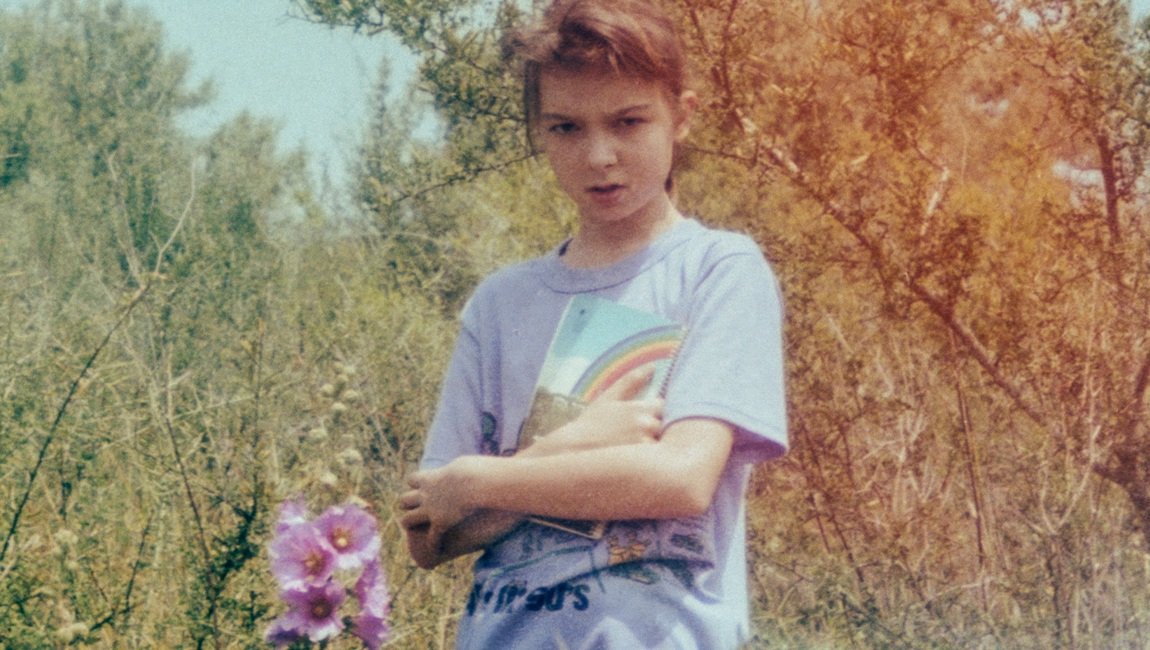
Much of the first part of Black Box focuses on Benivolski’s research, going through her old family photos as well as Israeli archives to collect evidence of al-Bassa’s existence. In the film’s strongest chapter, “The Little White House,” Benivolski identifies a single home on a high hill, one she remembers from her childhood and that keeps appearing in both family snapshots and official military images. In a place where the landscape is constantly being destroyed and rebuilt in order to erase any traces of Palestinian life, this structure remains like a silent witness. In its combination of personal memory and official records, “The Little White House” recalls the best work of Harun Farocki or Lawrence Abu Hamdan, or perhaps — even more specifically — the documentary work of Israeli filmmaker Amos Gitai.
“The Little White House” would be one of the year’s best films on its own, but Benivolski surrounds it with different kinds of discourse, with the viewer asked to consider how these registers of information bounce off one another. In one segment, Benivolski tells the story of a Palestinian family whose home is repeatedly raided. Handful by handful, the soldiers steal pictures from the family’s photo album, and Benivolski learns that the Israeli Ministry of Defense contains a massive archive of such stolen photos, classifying them according to their own internal categories. As we see a series of still images of Palestinians and Israelis going about their lives (which includes the frequent wearing of gas masks), Benivolski asks us to consider the dehumanization implicit in this disciplinary archive.
There are other chapters of Black Box whose overall purpose is less clear. One sequence shows images of the sea that have been distressed and scarred through hand processing, while another, labeled “Interlude,” fixates on the face of a one-year-old baby. That interlude recalls portions of Brakhage’s Dog Star Man, with its focus on the innocent, untutored gaze of the preverbal child, while the sea footage resembles any number of materially-oriented experimental films. The general scope and sprawl of Black Box allude to a particular history within the Canadian avant-garde, of expansive, variegated feature films in which coherence is not immediately evident — films like Jack Chambers’ The Hart of London, Joyce Wieland’s Reason Over Passion, and Michael Snow’s Rameau’s Nephew.
But this fragmentation serves a somewhat different purpose in Black Box. Benivolski seems to understand that it is not her place to make a grand, summative statement about the Nakba or the plight of the Palestinian people. What she can do, and what she does quite well, is articulate her own position as a former Israeli who has rejected Zionism and sees herself as an ally of the Palestinian cause. In one of the later chapters of the film, “being quiet,” Benivolski describes an assault she experienced at a friend’s house, and how young Israeli women are often subjected to sexual assault in dark underground bomb shelters. She treats her own experiences as further evidence of the toxic masculinity that inculcates Israeli men into violence. In a subsequent chapter, Benivolski describes growing up poor in Shlomi, and how Israel has used borderlands as slums in order to protect the more elite areas from direct attack.
This is very tricky territory. Benivolski makes comparisons between Zionist fascism and the broader abuse of women and the lower classes, and this could feel like special pleading — “we are victims too” — if the tone were off. But Black Box doesn’t try to equate these different forms of violence. Rather, the film places them side by side to suggest the path of Benivolski’s own political awakening. She felt these correspondences as elements of a more general sense of unease and unbelonging, a refusal to become the kind of docile subject that the culture demanded her to be. Black Box emphasizes that this is a material process, and just as much as Benivolski must look into the landscape to find the layers of history actively erased by Zionism, she must look inward as well, to discover what else has been actively erased.
Comments are closed.