
Chadian director Mahamat-Saleh Haroun has staked out a strong, consistent ethic across his career. His films champion the cause of the outcast, the foreigner, the troublesome figure whose very being disrupts the habits of tradition. This perspective has no doubt been informed by his own straddling of distinct cultures, as an African Muslim filmmaker trained and educated in France. But Haroun’s films are never staged as simple confrontations between old and new ways. Instead, he identifies prejudice and misogyny as trans-cultural phenomena, and his films often explore the ways in which tribal or religious rituals are distorted and mobilized in order to justify bigotries that were already in place.
There is an element of simplicity to Haroun’s narratives, and sometimes they can seem anti-dramatic, as if the point were merely to direct our attention to some problem in the social fabric. But Soumsoum, the Night of the Stars demonstrates the reasons why Haroun’s concerns are evergreen. This is a film about the scapegoat, an anthropological structure that is neither traditional nor modern, but has mutated over time to serve the needs of those in power. In this case, the members of a Muslim community vilify Aya (Achouackh Abakar Souleymane) because of a series of deaths during childbirth. Rather than examine the material conditions that contribute to maternal mortality — ones that any NGO would happily identify — the village has decided that Aya is a demon and must be shunned. They even go so far as to withhold medicine from her, which hastens her death.
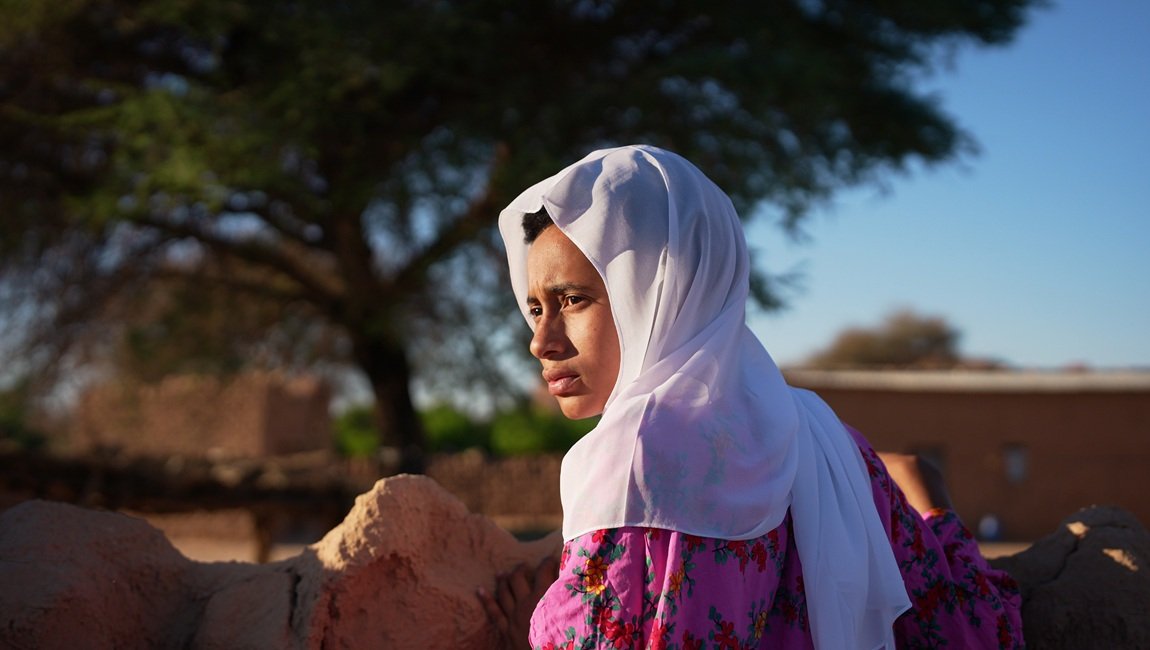
Soumsoum is a story told from the point of view of 17-year-old Kellou (Maïmouna Miawama), an independently minded girl who is herself viewed askance by the villagers. Her mother died during a childbirth overseen by Aya, and various people casually claim that this is a sign that Kellou herself is cursed, “born in blood.” She is not permitted to be with the Baba (Christ Assidjim Mbaihornom), the boy she loves, and the fact that her father, Garba (Ériq Ebouaney), is an immigrant only adds to her marginality. When Kellou befriends Aya, who becomes a surrogate mother to her, the lines are firmly established. Kellou has gone against the tribe, and she must be either reined in or banished.
Haroun’s early films reflected an unadorned realism that, while skillful, was essentially functional. Over the years, he has perfected his craft, and although Soumsoum is not as conceptually rich as 2021’s Lingui, the Sacred Bonds or his underrated, Paris-set 2017 film A Season in France, the new film is perhaps his most vivid. There is an undercurrent of animism in Soumsoum, one which becomes thematically pertinent but is evident stylistically in Haroun’s detailed attention to the Chadian landscape, especially the network of caverns on the outskirts of the village. This may also be Haroun’s first film to employ special effects, as one particular rock formation unexpectedly comes to life.
It’s evident that Haroun is trying to simultaneously decry superstition and articulate the value of ancient forms of spirituality, ones that are sometimes perceived as being at odds with Islamic practice. Soumsoum cannot achieve this balance in an entirely satisfactory way. Kellou is presented as a young feminist whose identity bristles against patriarchal tradition. But then we learn that she has visions, and her access to the supernatural connects her to a suppressed matrilineal magic. Haroun wants to thread a tricky needle, respecting Islam, Western rationalism, and ancient African tribal wisdom, but sometimes these discourses simply clash. Soumsoum, like Haroun’s other films, wants to find a way to forge them all into a progressive humanism that respects the old ways but offers freedom to the individual. It’s a noble ideal to be sure, but it’s a task Soumsoum, unsurprisingly, cannot accomplish.
Published as part of TIFF 2026 — Dispatch 5.
Comments are closed.