
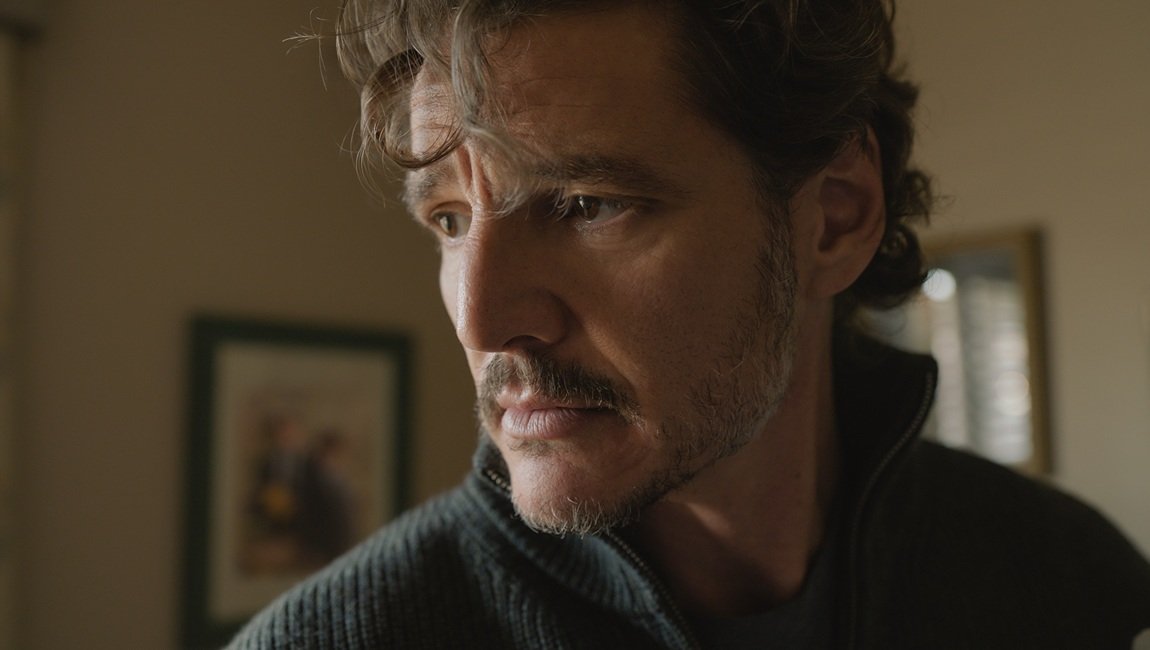
Alex Serian has been away for a long time. At the start of Tony Gilroy’s Behemoth!, the gifted cellist (played with great commitment by Pedro Pascal) has just returned to Los Angeles and is sitting in his first recording session after years of gigging across the country in symphonies and informal quartets. The mood in the room is warm, as if he were returning to summer camp, but tempered by a mournful reminder of how quickly this fickle business has left behind or spit out its dedicated practitioners to make room for new faces. He’s caught in a current of ongoing dramas and frustrations, some interpersonal, others aimed implicitly at a changing (some might say dying) industry.
Los Angeles, as the movie capital of the world, is a shell of its former self — we all know this, perhaps no one more so than Gilroy. He’s been out of the feature film directing game since 2012, when he helmed a rather poorly received reboot of the jet-setting Jason Bourne series, for which he wrote the screenplays for the original, Matt Damon-starring installments. Afterward, he turned his focus toward (or was confined to) streaming television, including writing 28 episodes of House of Cards, and creating and writing (but not directing) the hit Star Wars TV show Andor.
By setting his return to filmmaking in the world of film scoring, Gilroy establishes its synecdochic relationship to the movie business writ large, which also works in unpredictable, halting rhythms. Behemoth!’s own mysterious rhythms quite literally stop and start with the conductor’s baton, whereby music’s inextricable power over memory generates a series of dramatic flashbacks into Alex’s life. Suddenly, we have the opportunity to learn how he may have found himself in his current position, when a gig with the Chicago Symphony unravels before the wild, possessive threats of his then-girlfriend, Carole (Olivia Wilde, hewn just as sharp and angular as the emerald that inspired her silk dress), and a disastrous, near-fatal car crash while trying to escape. His cello in pieces, Alex returns to Los Angeles to care for his ailing mother and assemble the similarly shattered pieces of his personal life into something playable.
To do that, he takes a holistic view of his past, from the trials of selfish, hard-charging artist parents, to a string of seemingly failed relationships, a too-early initiation into sex, and an unspoken, one-sided rivalry with his older brother, to arrive at the clarity required to do something different when given the chance. Music is the vehicle to that clarity, and Gilroy deploys a murderer’s row of film composers, including long-time collaborator James Newton Howard, as well as Alan Silvestri, Michael Giacchino, and Michael Abels, to get him there. The spy chase, the love theme, the comic relief — all quintessential elements of movie scores — play as checkpoints in Alex life, shepherding him and the viewer across major milestones, from his early gigging days in Dallas, where he meets Nadia (Eva Victor), a talented violinist with whom he engages in a passionate but brief affair, to Los Angeles in 2016, when he attends her memorial service and discovers her six-year-old musical prodigy daughter, Viviana. It’s in these and other moments that the role of movie music is clearest: to jolt Alex out of his persistent passivity and into a kind of action, both literal and metaphorical.
Behemoth! could have played like a sappy paean to the power of movie music — and in some ways it does. The fake-but-real scores that act as scaffolding for the film are a touch hacky, relying on cues and progressions that the average moviegoer has heard before in countless minor variations. But their cliché hues are also part of the point. Gilroy treats Alex’s trips down memory lane and his present-day life with both clear and misty eyes (although a montage of previously seen flashbacks at the film’s emotional crest misses the mark entirely, and ends up as pure corn).
Both Behemoth! and Gilroy’s directorial debut, Michael Clayton, reconstruct the dramatic crescendos to their characters’ lowest points in life. They both also ask the same essential question: “How did we get here?” But Behemoth! has a soft, raggedy quality that stands in sharp relief to the grit and callousness of Gilroy’s first film. Part of this could be due to the simple passage of time, which makes us more sensitive and permissive; the later work of many filmmakers adopts similar forgiving curves and textures. Further consideration directs the viewer to the film’s driving force. Pascal’s performance, while clearly studied (his cello playing is remarkably accurate and bears a deep knowledge of how emotion flows through the wrist, fingers, and through the tilt of the neck), rustles like a deep breath, weary and exhausted. He lacks the cutting edge that made someone like Clooney’s Michael Clayton both subvert and surpass its actor’s “Movie Star” limitations; Pascal merely suppresses, rather than subverts, his public teddy-bear persona and megawatt smile. For some, that will suggest the perfect match between star and material; for others, it might be a sign that this otherwise excellent film could have reached a higher key.
Published as part of NYFF 2026 — Dispatch 6.
Comments are closed.