
Even among the film festival cognoscenti, experimental films sometimes inspire their fair share of confusion. This is to be expected, since the films in question are operating within parameters different from the ones to which we are accustomed. However, even within the rare air of avant-garde showcases like TIFF Wavelengths or NYFF Currents, a film stands out as a particular kind of UFO. Several years ago, when the Ann Arbor Film Festival was under the directorship of David Dinnell, on the final day they would hold a screening called “What the Hell Was That?” It featured works from earlier in the festival that had left many festivalgoers at a loss, and it provided a chance for a second viewing and collective discussion, an attempt to wrestle with films that were less than forthcoming in revealing their mysteries.
James Richards’ film Fevers is precisely the kind of film object that requires a second (or third) viewing, the sort of work that leads even intrepid filmgoers to wonder, indeed, what the hell they just watched. Up to now, this writer had only known Richards from two very impressive films he made in collaboration with Steve Reinke, What weakens the flesh is the flesh itself (2017) and When We Were Monsters (2020). Although Fevers is radically different from Reinke’s work, the two men clearly share a certain sensibility. Like many of Reinke’s video works, Fever is constructed less as a coherent set of statements than a space for jostling ideas, where the meaning of one thing butting up against another is not immediately evident. Relationships are entirely intuitive, and one gets the sense that the finished work is primarily a record of the artist’s free association process.
Whereas Reinke’s calling card is his verbal narration, most of Richards’ film is silent. But the first 10 or so minutes contain a strange, poetically dense text that appears along the bottom of the frame as subtitles. This portion of Fevers is dominated by a rapid black-and-white flicker, one that is digital in texture, setting it apart from the classic flicker films of Conrad, Kubelka, and Sharits. However, this itself is a bit deceptive. Richards has in fact appropriated Tony Conrad’s The Flicker (1966) for this opening sequence. The optical quality of a digital flicker is palpably different from the celluloid version, which rapidly alternates between total darkness and pure projector light. No digital translation can darken or illuminate the screen that quickly, so the flicker in Fevers lags, introducing the problem of time and its impact on the body.
This delayed action is relevant to Richards’ primary themes. Against this throbbing raster, Richards offers a story of a cave in which prehistoric impressions of painted hands can be found, marks of a long-lost humanity situated against the pounding sea. The viewer is addressed as “you, who are named, you who have an identity,” and this suggests that the speaker is someone who lacks those distinguishing features. The narrator continues to insist that they are screaming “I love you,” that they love whoever might possibly hear the message. But this “message,” it turns out, is also appropriated from another artist’s work. The subtitles are from the English translation of Marguerite Duras’s Les mains negatives (1979), a short film in which this text is spoken (in French) against roving images of the streets of Paris. And so, Duras’ text is about the distance between the past and the present, and Richards’ use of the text is itself a gesture to a different, anterior moment.
Much like Richards takes Conrad’s analog flicker and titrates it through the digital, the next segment of Fevers is partly a recapitulation of Duras’ winding cityscape. The second movement of Fevers impersonates a roving camera within the space of a cave, although it is evident that what we are actually watching is digital animation. Richards’ “camera” finds marks and holes chiseled into the cave walls, all of them suggesting human faces of varying degrees of definition. Given the first section, with its absence of visuals and description of painted hands, one might be forgiven for thinking Fevers is charting some sort of evolution. But time is elastic in this film, presuming it is present at all. The pulses of pure light might be biblical, and the cave images might be artifacts from our ancestors. But this alleged prehistory is clearly fabricated with contemporary digital tools.
After this passage, Richards shows us time-lapse footage of animals eating a dead carcass, and a rapid succession of close-ups of human eyes with a wide array of apparent disorders. From here, Fevers veers into found footage that has been polarized or otherwise manipulated: images from art history, medical footage, more wild animals, a brief camera arc around a room, animations that approximate cell division, and a looping shot of a candle shaped like a large gummy bear, melting away and then reforming. Much of this section is accompanied by a rhythmic, repetitive tuba sound, one note slightly flanged.
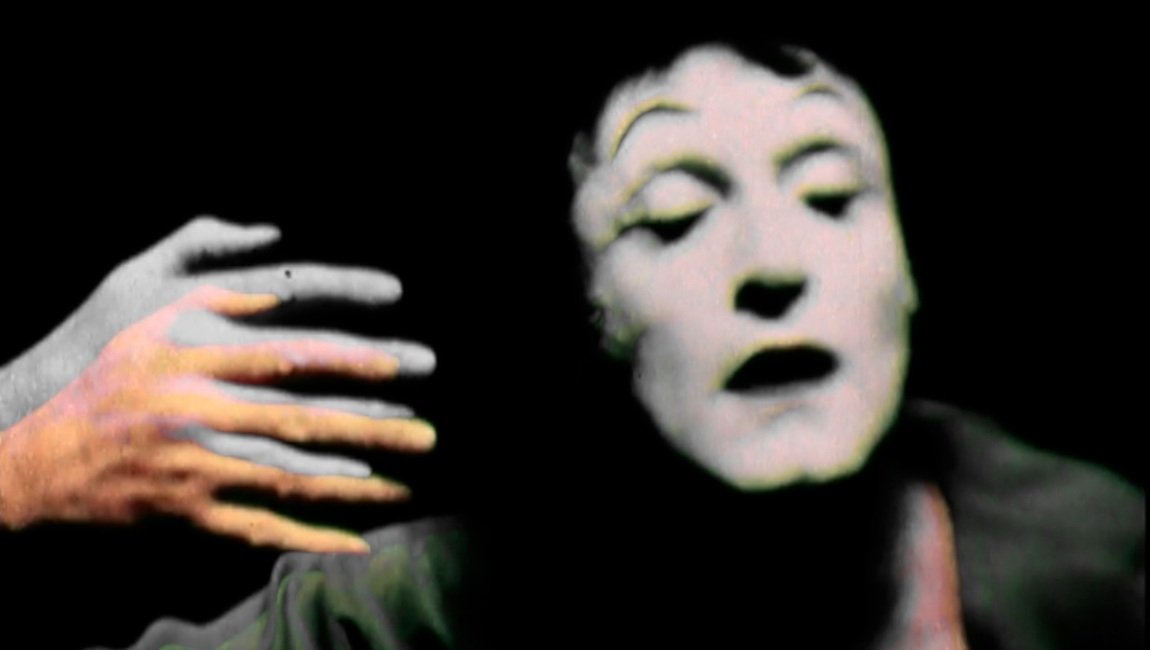
From here, Richards introduces high-contrast images of birds and other animals, either taken directly from the motion studies of Muybridge and Marey or designed to resemble them. There is a Pierrot figure crouching on a stage, and finally, more distorted, high-contrast footage, this time of people running and dancing around a fire. It is deliberately unclear whether this is some religious rite or a fascist bonfire, whether spirits are being summoned or verboten objects destroyed. What is clear is that the participants are flailing in a state of ecstasy.
But here’s the important thing about Fevers. As haphazard as its images may seem at times, the soundtrack is dense and precise, a true feat of musique concrète. During the opening flicker, we hear rushing water that evolves into the Doppler-effect sound of cars zooming down the street. We hear airplanes and helicopters, shouts of crowds, all sounding on a bed of grinding metal noise. The flicker takes on a mechanical inevitability, as we are ourselves being subjected to the processes of some infernal machine. During the cave drawing segment, single tones build into symphonic chords, pure sound attaining the complexity of composed music.
It seems infinitely easier to explain how Fevers makes a viewer feel than to articulate what it means. Certainly it is a film about the paradoxes of progress, the impossibility of knowing just how much ground humanity has managed to cover in its attempted development. Richards’ use of Conrad and Duras, two defining artists of Modernism, speaks to this conundrum, since his particular use of their work seems to place them in a distant, almost prehistoric past. The primordial opening moments of the flicker were complicated by the cacophony, the simple emptiness of the image track paired with an audio track thick with technological signifiers. Fevers began to seem like an epochal palindrome, wherein we were asked to consider the era prior to civilization alongside our present era, confounded to such an extent that it was no longer possible to discern past and present.
But maybe this reading speaks more to this writer’s frame of mind than any firm evidence from the text. How does one define civilization? One possible definition: the attempt to establish structures wherein the greatest portion and greatest diversity of human beings might attain their potential. There have been many different ideas about how to achieve this, many of them spectacularly wrongheaded, some of them deadly. However, we are now facing a moment when the basic project of civilization is itself being actively undermined by some of the most powerful people on the planet. There exists a cadre of techno-fascists who are actively invested in the destruction of human history. They represent a literal, self-professed counter-Enlightenment, a group of people who are for teen pregnancy, for white supremacy, for the deskilling of the population, against global literacy, against democracy, and, for the most part, against self-determination for anyone besides themselves. Like the burning of the Library of Alexandria writ large, we have now achieved a pinnacle of technological advancement, and it is being marshaled to drive 99.999% of us back to the Stone Age.
Is this what Fevers is about? It’s difficult to be sure. However, one thing is certain. Richards depicts progress as indistinguishable from a horror show, a cavernous echo in which a hypothetical Last (or First) Person calls out in the darkness, to anyone capable of listening, anyone who might still have a name.
Published as part of NYFF 2026 — Dispatch 8.
Comments are closed.