
After having seen A Real Pain, one might ascribe a certain set of proclivities to Jesse Eisenberg-as-director: an easygoing affability, a penchant for the gentle ramble, and, most prominently, a lackadaisical sensibility in the spirit of Linklater or Holofcener. He stumbled into a quiet profundity with his second feature, and one might reasonably expect him to continue in this vein considering the subject matter of his newest film, The Debut. One might even assume it would resemble that far better low-key American film about the same milieu, Patrick Wang’s A Bread Factory. One would be wrong.
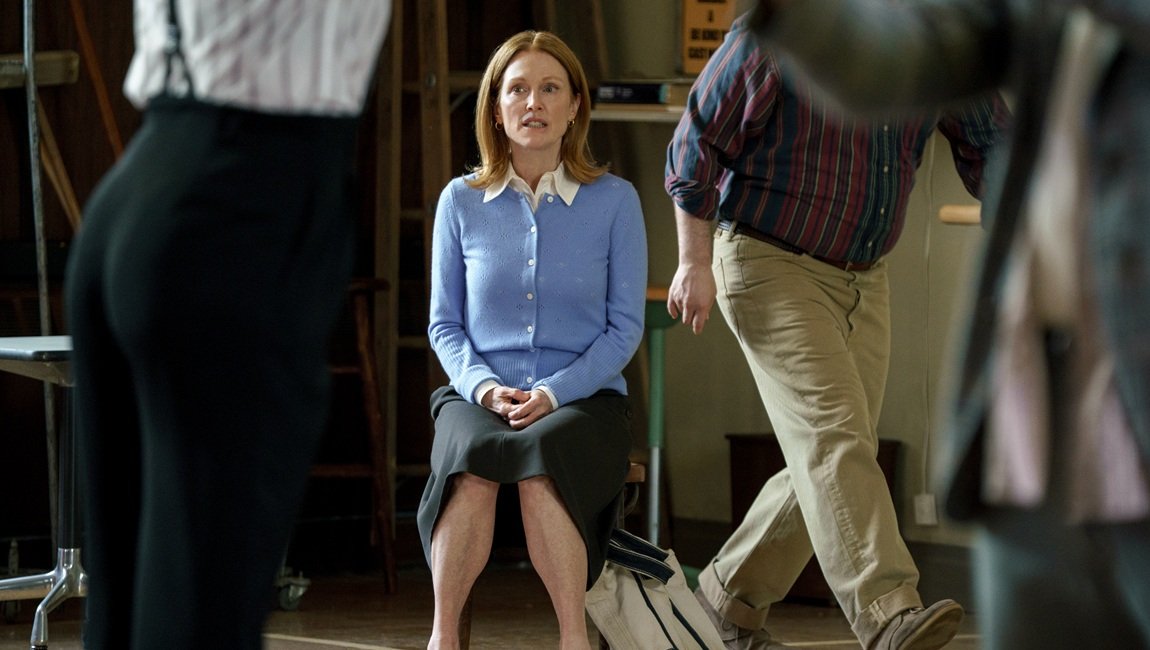
Set in the wild world of community theater, The Debut charts the modest dramatic ambitions of alienated housewife Mona, who auditions for her town’s production of Nosy Neighbors, a fictional musical with book and lyrics by Eisenberg. She doesn’t get the part, yet she quietly obsesses over her loss in the weeks following her audition. One night, parked outside the theater — in a sense stalking the cast and crew — she decides to accost the show’s director, Jerry (Paul Giamatti), for not getting back to her. He offers some glib remarks and quickly dismisses her, only to call her back late at night with an offer: Serena Cherry (Bernadette Peters, who returns at the end of the film to invoke a deeply unearned nod to Jessica Lange’s Angelique from All That Jazz) has quit because the part was too small.
A Bread Factory is about the power of community theater, how it’s a space not only for expression but solidarity. It affirms that, like all politics is local politics, all art is really local art. The Debut, however, has one eye on the local scene and another on Hollywood, drenching its cynicism in a Brooksian (James L., that is) gloss. It feels not like a loving send-up to community theater, but a letter written with a poison pen: The Debut is a calculating satire that condescends to the very people it ostensibly seeks to elevate. Like nailing your mark on stage, Eisenberg neatly hits narrative beats with a spin on the heel and a twinkle in his eye, yet his operating principle causes one to wish he had stayed in that messier, more empathic mode.
Mona begins rehearsals as timid and in way over her head, but, after a Whiplash-y showstopping pivot, she falls all the way into her performance as the superintendent of the apartment building where Nosy Neighbors takes place, striking a domineering pose and taking an overbearing approach to what is effectively a bit part. She retreats into method acting as a distraction from the constricting boundaries of her housewife trappings, a sort of Better Living Through Theater self-help program Jerry concocts for her — which goes totally awry.
There’s commentary to be made on the horrific solipsism of suburban America such as Eisenberg seems interested in here, certainly — it’s just that this particular critique starring Julianne Moore was already made by Todd Haynes with Safe over 30 years ago. Of course, 30 years is plenty of time for Safe to have evaporated from the cultural consciousness so that Eisenberg can freely pull from it, but unlike Haynes, he can neither modulate complex emotion — The Debut is pitched at either hysteria or Zoloft-level depression depending on the given moment — nor muster the necessary empathy for his naïve protagonist. Mona is an empty-nester who succumbs to the pressures of the spotlight, yet rather than critique the egocentric system that enables her fall, Eisenberg thumbs his nose at the suburban bumpkin and pins the blame on her. The character is all anxious mannerisms; moreover, she’s a terrible actor. Playing this so Mona doesn’t come across as a total caricature is a monumental challenge, one that Julianne Moore is, unfortunately, up for. She flicks through feelings like a Rolodex and sells Eisenberg’s cute dialogue; the film asks entirely too much of her, and she willingly sacrifices her talent at the altar of parody.
Eisenberg’s form has evolved — rather, transmogrified — to meet the content. When Mona tells her husband she got the part, the camera pushes in, and a spotlight shines on her; the camera will whip back and forth during pressure-cooker scenes to reflect the whirlwind Mona finds herself caught up in; and a toilet becomes a motif expressing Mona’s impulse to break out of her dull routine. Anything, it seems, can become a storytelling device if you cut back to it enough.
There is a single moment at the very end of the film one could refer to as identifiably Eisenbergian (should one have the desire): Mona infiltrates the theater late at night, only to find Jerry playing sad chords on his piano in the tiny apartment he lives in above the stage. He admits that despite his anger at Mona for her prima donna approach, he envies her. He gave up on his acting career long ago, and he wishes he had the same enthusiasm for the craft as she does. It reverses the power dynamic, slashing the Goliath down to David-like size, similar to Benji’s humbling in A Real Pain’s final moments.
But this is not where The Debut ends. The Debut somersaults into a sour note, resting on an ambiguity which shades Mona as either redemptive or menacing depending on one’s own relationship to both the character and the performing arts in general. It’s an evasive act of legerdemain that only magnifies Eisenberg’s cruel diffidence toward his characters: cutthroat, insecure, angry people looking for the love and acceptance they can’t find at home. In the world according to Jesse Eisenberg, that’s showbiz, folks.
Published as part of NYFF 2026 — Dispatch 9.
Comments are closed.