
A couple of weeks ago, I went to a screening of Tsai Ming-liang’s Stray Dogs (2013) at the Metrograph in Lower Manhattan. I am a forgetful person, which is why I always take notes during a film, no matter whether at the movies, in the classroom, or at home. Always, except for this one, that is. Ironically, it became one of the most memorable screenings of late, which had little to do with the film’s infamous cabbage scene. There was one person in the room who, the audience quickly seemed to conclude, had some kind of condition that made it impossible for them to remain quiet for any length of time. Whether it be during the five-minute scene in which Lee Kang-sheng, reduced to a human billboard and veiled in a clear rain poncho, recites with ever-greater despair the Man Jiang Hong poem on a Taipei traffic intersection, or the stunning reverse shot that draws the film to a depressingly apt (or aptly depressing?) close — the young person would stretch their loud yawns to a maximum and squeeze out giggles at “inappropriate” moments, occasionally accompanied by expansive gestures noticeable even several rows behind.
I do not doubt that to many this would seem an unpalatable proposition for a filmgoing experience. The purchase of a ticket, the many might argue, entails the promise of non-disturbance, an implicit contract between the moviegoer and both the cinema and the other audience members. I would be lying if I said that I was not distracted from the first incident on — up until the end of the film. My thoughts kept wandering off to the young person and their company, whom I took to be a couple. I wondered whether this was their only evening in a while that they could go to the movies, wondered what I would do in this situation, and how the young person might have felt. Whether a late-night outing to an arthouse cinema meant a greater or smaller effort for everyone involved, compared to other activities. If I were in their shoes, would I be more considerate toward an unknown audience than to my companion who might, despite everything, take joy in this kind of night out? Should this kind of screening experience not be a much more common occurrence? In the eyes of another audience member in the sold-out room, who, once the end credits unfolded, immediately jolted from his seat to shout at the person: “Thank you for ruining my evening, asshole!” — the answer was an emphatic “no.”
The incident stayed with me. What are the conditions that render this such an out-of-the-ordinary event? Or, put the other way around: how seriously do we take the demand for accessibility in public (if commercial) spaces? These questions, inevitably, made me revisit the 2025 essay “Access Against Common Sense” by Jordan Lord, who wrote: “[A]ccess features for disabled audiences are almost always individualized and/or designed to be experienced separately from the version experienced by the abled audience.” It is a practice, Lord continues, that “divorces both access and cinema from their roots in sociality.”
In their own work, Jordan Lord takes these concerns seriously, which is why their film Shared Resources (2021), an essayistic family portrait shot over several years, features open captions and audio description (in their most recent film, the deconstructivist 35-minute archival documentary Concealed and Denied (2026), Lord withholds the direct material used for their exploration of a media landscape that has gradually shifted to the right, evoking it instead through their bare voice). They posit:
“[A]ccess to all moviegoers is a fundamental dimension of filmmaking. Whether or not a filmmaker has considered making their film accessible to disabled audiences, a film’s access features—or lack thereof—show that a set of decisions has been made, implicitly or not, about who belongs in the audience. It’s not simply that certain audiences are not offered the features that might make a film accessible to them; industry norms that regulate the concept of how to enjoy a movie also judge who properly belongs in a theater and whose presence is a potential disruption acceptable only when neither seen nor heard.”
This leads us back to the “disruptor” in the audience, but it also — finally — lays a useful foundation for discussing Éric Baudelaire’s experimental documentary For the Moon (Car la lune), which premiered in the Currents section of the 2026 New York Film Festival. The film takes its French title from a passage of Samuel Beckett’s French-language novel Molloy, the first installment of his trilogy. Whereas the English title For the Moon holds ambiguity as to its directionality — Is something being done to honor or in service of the moon? Is someone headed for the moon? — the French proves much stricter. There, “car” can only figure as the causal conjunction that emerges in the English translation of the programmatic epigraph: “For the moon was moving from left to right, or the room was moving from right to left, or both perhaps together, or both were moving from left to right, but the room not so fast as the moon, or from right to left, but the moon not so fast as the room.”
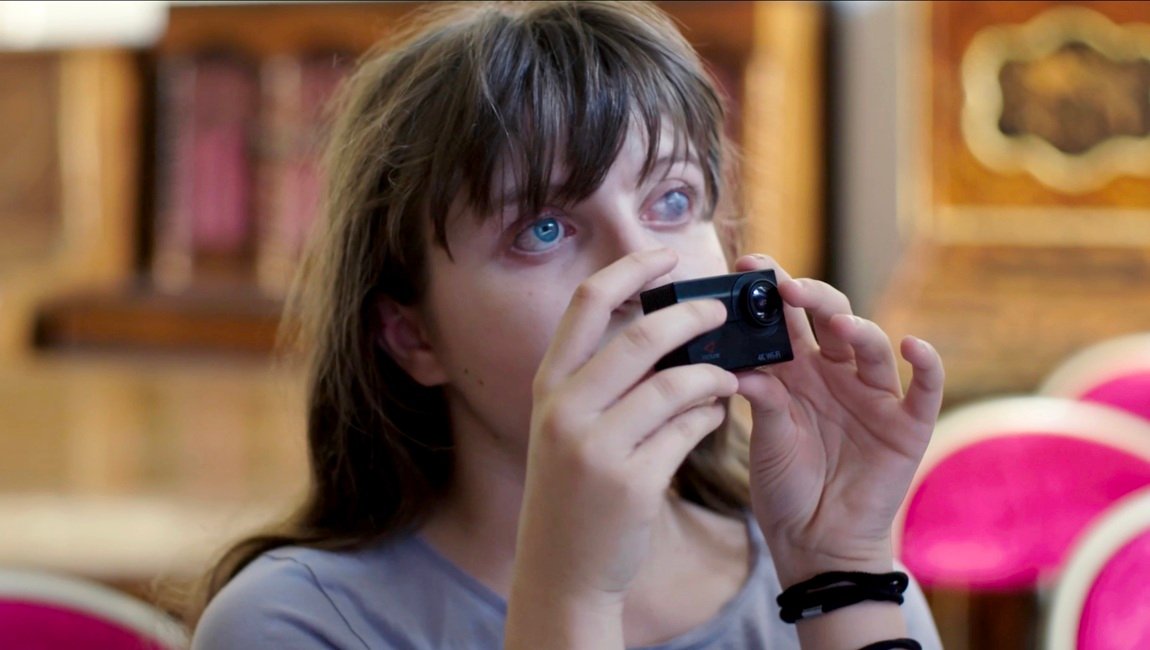
The disorientation in and of Beckett’s prose, presented as unfurling intertitles, prepares us for what is to come. Shot at the Campus Louis Braille (named after the inventor of the tactile code) at the Institut National des Jeunes Aveugles in Paris, the film captures aspects of the lives of five adolescent girls with visual impairment within an institution specifically designed to enable a high degree of independence. What commences in an observational mode captured by DP Claire Mathon (who has worked with Baudelaire before, as well as with Céline Sciamma, Alice and Mati Diop, and Alain Guiraudie) and is reminiscent of a Frederick Wiseman or a Claire Simon film, gradually transitions into cinéma partagé, a prism of diaristic entries filmed by the students Jade Ebara Ossebi, Iris Fontanella, Kadiatou Diakite, Crystal Lau Chang, and Mèï Jendoubi themselves with Sony camcorders. The opening scene seamlessly picks up on Beckett’s words and presents us with two pairs of hands in close-up, the older one helping the younger navigate a wooden miniature model of the institute. Following the instructions of the female pedagogue whose face remains off-screen, the child has to learn by heart: the girls to the left, the boys to the right. Orientation, we may infer, is a matter of habituation.
With like precision and perspicacity, Baudelaire captures several other moments of quotidian consequence: a boy struggling repeatedly to press the lid onto the open pasta container, others learning to write via braillewriters, a match of goalball — a sport developed for athletes with visual impairment in which two teams, wearing special blackout eye shades, attempt to throw a ball with bells inside into their opponents’ goal. It’s a rather episodic mode in which this early segment of the film explores the goings-on inside the institute, one that refrains from the scaffolding devices of protagonicity — the focus resting on the body and its uses rather than on faces — and explanatory voiceover. Crystallizing through the extended time spent with the people in the institute, Baudelaire’s vision in For the Moon clearly privileges the experiment over a narrative arc.
As Jade, Iris, Kadiatou, Crystal, and Mèï become the protagonists, the observational perspective increasingly gives way to the participatory one, up to a point where the baton has been handed over entirely to the five students of the Campus Louis Braille. It is a premise both compelling and moving: what will be shown by those who cannot see? But perhaps, there is already something to take issue with in this question: “For us, listening, touching, tasting, and feeling is seeing,” we hear Kadiatou say. And: “We even use the term for sighted people ‘I watched a film.’” Kadiatou’s family, we learn in the same scene, had moved to France upon hearing that French clinics were now able to separate conjoined twins — “a miracle” — believing that if there was a place to help someone regain their eyesight, it must be France. One of the group, Iris, tells us later that the midwife who had delivered her, once she had realized that Iris’ eyes were white, had tried with all her might to dissuade Iris’ parents from giving her this name. Clearly, Iris and the others have told their life stories many times, to themselves and to others, and their tellings oscillate between anecdotes, theoretical reflections, and the ineffable. “I was born blind, my brain doesn’t know what seeing is,” Kadiatou says. Iris, who lost her right eye at the age of nine and, at the beginning of the film, awaits surgery to remove her other eye, is happy that she is still able to see colors in her dreams — and hopes that this will remain so forever.
There is more beauty — even sublimity — in this film than can be acknowledged here, much of it owing to the sprawling energy, musicality, and openness of Baudelaire’s subjects and collaborators. Still, several things can be true at once, and some of the directorial decisions lead me back to the beginning of this text. What does it mean to make a film about a group of people with severe visual impairments? One mode of showing, a recurring one, finds a particularly convincing answer when the camera tracks the students as they navigate the institute’s winding corridors and tell the audience what they perceive their environment to be like. The act of designation works threefold: it demonstrates the speaker’s sense of and orientation in the world, it activates the sighted viewer to measure the impressions of their observations against what is said, and it communicates what unfolds on the screen to those audience members who cannot see. For the most part, however, a person without eyesight would not be able to follow, a fact underscored by the aforementioned epigraph, which exists as text but not as spoken text. And even if a given cinema, as some do, were able to offer a generic audio description, this would simply not do the film’s emphasis on perspectivity justice, since many of the scenes are directly tied to the — paradoxically captured — perspective of Jade, Iris, Kadiatou, Crystal, and Mèï.
For the sighted viewer, the shift of cameras from the “professionally” shot scenes by Baudelaire and Claire Mathon to the low-res camcorder videos by the students creates the inevitable perception of hierarchy that Baudelaire, according to the end credits, appears to want to abolish. After their names, the credits read: “their images, their sounds, and their music.” Naturally, this acknowledgment is, only seconds later, followed by “images/Claire Mathon” and “directed by Éric Baudelaire.” It is a predicament that traces back to Jean Rouch, whose ostensible carrying of the banner cinéma partagé would routinely collapse in the end credits of his films, identifying him as the sole auteur. These are some of the contradictions in For the Moon. It is a film made about and to a considerable extent by people with visual impairment, but neither are they credited where it would matter — the authorship remains with Baudelaire — nor is the film, as screened, made with them in mind as an audience. It’s also, for those who will be able to see it, quite a marvelous thing to behold.
Published as part of NYFF 2026 — Dispatch 9.
Comments are closed.