
Ava DuVernay’s 13th is one of the most influential documentaries of the 21st century, for better or worse. Released at the tipping point between the Obama and Trump years, it struck a nerve in the shifting cultural ecosystem and set the template for many of the made-for-Netflix documentaries in its wake, emphasizing off-center framing of its subjects, a roving camera, and quick cuts to compete with the second screen. 13th is slick, but its very slickness made palatable the incendiary (and true!) notion that slavery is effectively legal today through a loophole found in the U.S. Constitution’s 13th Amendment that has been exploited through mass incarceration. As far as edutainment goes, you could do worse.
This is a claim that DuVernay (inadvertently) sets out to prove with her follow-up, 14th. Created not in competition with the second screen but in total capitulation to it, 14th crosses the line between politically correct and formally wrong: it doesn’t fight your attention away from your phone, but rather replicates the doomscrolling experience in all its twitchy horror. Infographics, colorful captions, shots that last fewer than five seconds, AI zombification of historical photographs — it’s political documentary for the Cocomelon crowd, an overstimulating buffet of sensations meant to appeal to a populace whose brains are melting.
Consider 14th an inverted 13th. Where the earlier film pokes holes in the Constitution, 14th argues in favor of preserving the document in light of Trump’s ramrod disregard for its tenets. It asserts that the amendments are just as important as the Constitution itself, which is hard to disagree with yet impossible to properly digest because of the film’s ridiculous pacing. The Constitution is quoted rat-a-tat under instrumentals for Kendrick Lamar’s “Alright,” Fleetwood Mac’s “The Chain,” and James Brown’s “The Breakdown,” intercut with commentary from a who’s who of politicians, PhDs, and commentators. For example: expecting literally zero familiarity with American history, DuVernay introduces A.O.C. to tell us that the Civil War was fought between the North and the South. And as we watch the parade of postulation, it slowly dawns on us that 14th is not really about the amendments at all; rather, the United States Constitution serves as window dressing for a cursory overview of all the outbursts of white supremacy we saw on our phones and have been enraged by these past 10 years or so.
The Unite the Right rally and its culminating car attack, the Charleston church shooting, the attempted insurrection on January 6, the cold-blooded murders of Alex Pretti and Renée Goode; all are represented here in one form or another. DuVernay takes nearly everything that made you want to chuck your phone at the wall and consolidates it into a neat, digestible package. One would think it’d be useful to have all this information in a single place; it’s a concrete reminder of events that have evaporated into the cold mist of social media algorithms, and it’s impossible to watch these images and not be agitated. Writer Jelani Cobb states that white supremacists erroneously believe “something has happened to this country in 50 years,” and on its face, he’s right: the fear drummed up by right-wing political leaders is a total mirage, and the violence done in its name is irredeemable. But there has been a change — an economic one. Reaganomics, Citizens United, and the vast accumulation of wealth by billionaires have irrevocably altered the very fabric of society, and right-wing plutocrats have taken the anxiety provoked by that change and spun it into widespread xenophobia and racism. Any film that doesn’t integrate capitalism into its critique of white supremacy is, at best, insufficient.
14th is not only insufficient, but it actively celebrates free market capitalism by proffering Ronald Reagan as one of its voices of reason and deploying AI to animate primary documents. Pictures of free men standing proudly, holding political office, free women sitting at desks, getting an education, and children playing with each other become dioramas that DuVernay pierces through in a bizarro 3D Ken Burns effect. The trick is integrated so the seams (i.e., failures) of AI are indistinguishable to an eye watching 14th on a 4-inch screen, but look closely enough at the periphery, and some of these faces briefly contort into digital screams. It’s baldly irresponsible filmmaking, and as the Buddhist monk Bhante Sujato said during a recent dharma talk, “when you’re participating in AI, it’s an inherently totalitarian philosophy. It’s not a technological project, it’s a political project.”
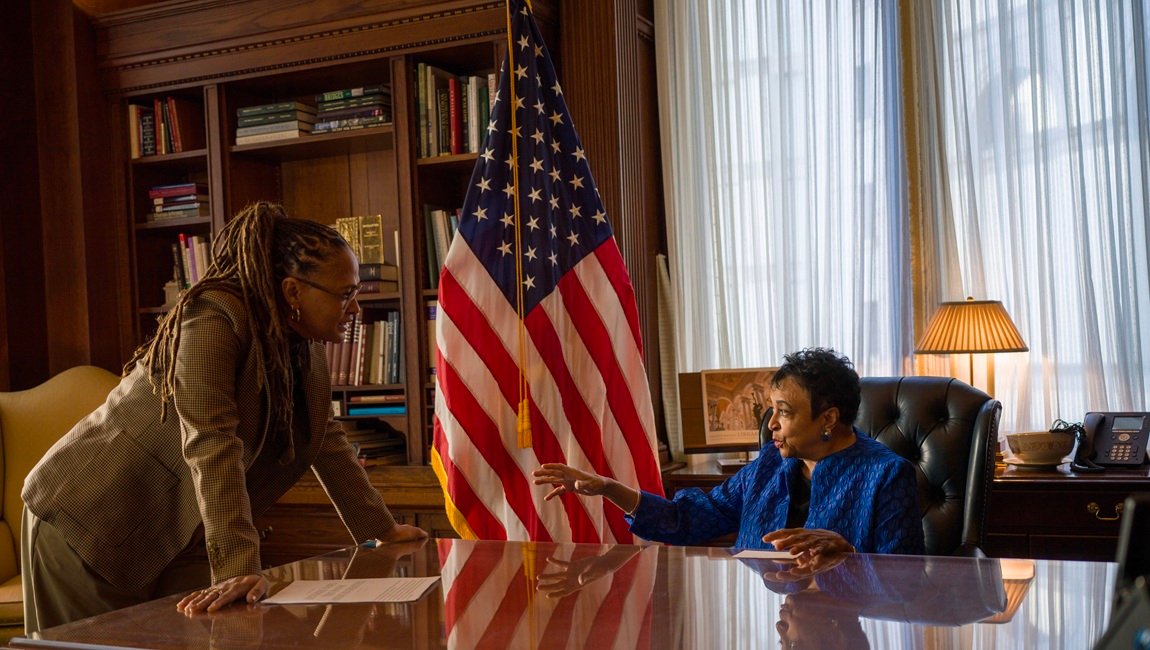
AI alone would be enough to disqualify the film’s rhetoric, but the rhetoric is so laughably easy that it situates itself comfortably with said use of AI. On the subject of birth tourism, DuVernay platforms a MAGA-ite Florida representative to say birth tourism is a major issue and a good reason to end birthright citizenship. She then puts up the stats proving that fewer than 1% of births in America are the result of birth tourism. Shortly thereafter, (now former) Press Secretary Karoline Leavitt falsely claims that Dr. Carla Hayden, former librarian of Congress, was loaning inappropriate books to kids, and then cuts to a disclaimer that the Library of Congress does not and has never loaned books to children. It’s just lay-up after patronizing lay-up, soothing the egos of those for whom civic engagement begins and ends with calling Trump supporters a basket of deplorables on Facebook.
14th is, ultimately, an important documentary. It demonstrates the limits of the neoliberal paradigm to address troubles unique to our time, and it gives voice to the last gasps of those who hold on to that order for comfort. At the very end of the film, Sherrilyn Ifill implores us to repair the damage done to the Constitution “if we have a democracy when we get out of this.” She’s right; we are in the midst of a major constitutional crisis, and perhaps democracy is hanging on by a thread. If democracy is to be restored, however, 14th will have nothing to do with its repair; if something better comes to replace it, 14th will serve as a document of a past best left behind us.
Published as part of NYFF 2026 — Dispatch 9.
Comments are closed.