
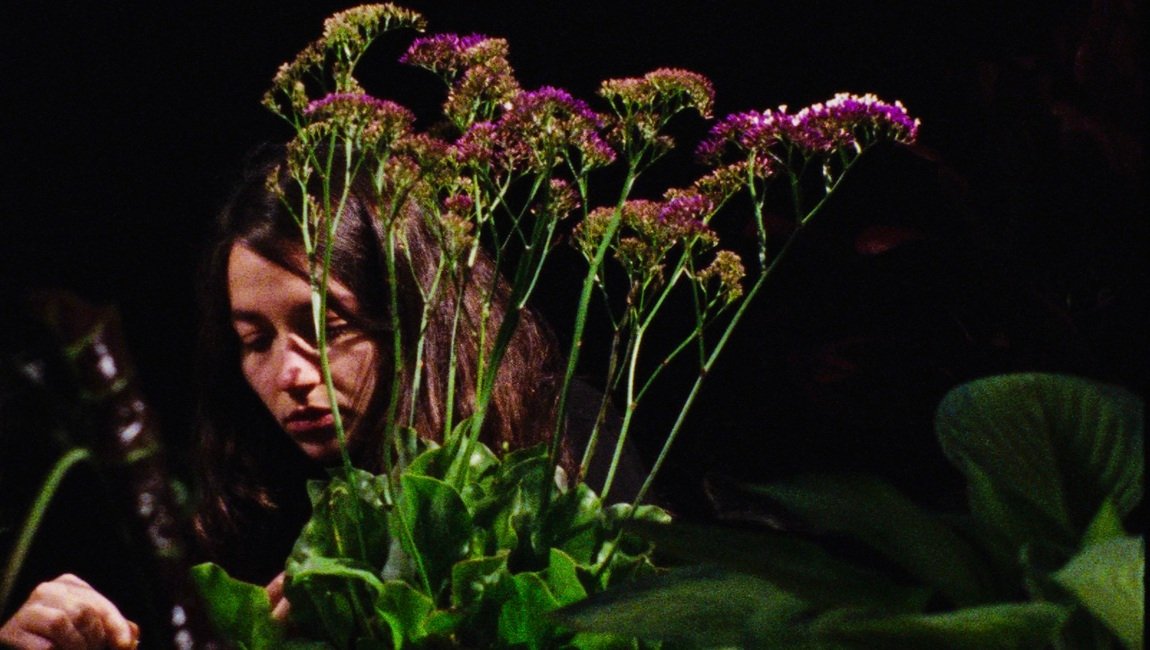
“Can the copy of something embody the truth of its original self?” The world we have built for ourselves is an ersatz one. We gaze at our screens, watching videos and listening to songs that are only digital replications of information received by sensors and converted into data. We flick through images of memories, replacing them rather than representing them. Leonardo Pirondi’s Tropical Fractals imagines a future in which this world we’ve built has, quite plausibly, become uninhabitable, and asks: if all we have left are copies, of what use are our original selves?
It’s a question not only for this imagined future, but for our present, too. In Tropical Fractals, a team of scientists live aboard a spaceship, having abandoned the dying Earth. All they have left of it are their memories and the archive data of it, held by the ship’s artificial intelligence, Museo. This machine is a reality made by humans, and now the machine remakes reality. But the machine’s interpretation of said reality is a flawed one, its pixellated recreations only approximating the truth of the original, not always with accuracy, and always at an intrinsic digital remove. Pirondi’s future is governed by AI, but so, and increasingly, is our present.
The scientists grow more despairing with each new diary log, their memories more disconnected from their new reality each time. One bemoans “a memory that no longer has a place to exist,” and chooses to spend her time in hypersleep rather than contend with the trauma this induces. What purpose has memory if there’s nothing to attach it to, no one else to receive it or identify with it? Her choice to sleep thus becomes a form of suicide, a way to forget, to erase oneself and thereby one’s memories. The dead, after all, have no trauma. If all hope for a bright future is genuinely lost, would extermination not be a relief? And did we not collectively commence our extermination when we set about destroying our planet, our only home?
In the movie, when Museo fails to display one prompted image, the scientist commands it to forget it; in reality, we commonly refer to a machine’s storage capacity as memory. If Tropical Fractals could be interpreted as validating the intelligence implied in the term “artificial intelligence,” it does so with reason — electricity flows through both machines and human minds, and neither memory nor the light viewed on screens is atomic in composition. Whether or not a machine can know something — and thus remember, and thus forget — is only slightly removed from whether or not humans can, and even then our memories are only copies of the original truth.
Cinema itself is a copy, and digital cinema is not a physical object, not a tangible art like sculpture, painting, or fashion. Poignantly, Pirondi shot Tropical Fractals on 16mm film, though still the information stored on those physical reels is, fundamentally, only a replication. But it is its own object, and what he communicates through it has its own value. The retro tech of Museo and the spaceship suggests an inability to see a world to come through contemporary eyes — the optimism of the bygone era of 20th century futurism the only means of visualizing the future. But Pirondi’s way forward finds optimism not in technology, but in nature.
As the scientists in the sky mourn the world they’ve left behind and the lack of truth in their recreations of it, one man still wanders the Earth. He collects objects from a time the planet has now forgotten, as the natural world reclaims the space vacated by both humans and machines. At the movie’s end, he bathes beneath a waterfall, paddling against its flow. He may be swimming against the tide, so to speak, but his is a life of contentment compared to the scientists’ emotional desolation. His memories are still being made. Tropical Fractals asserts that hope for a bright future is not lost, even if hope for humanity may be.
Comments are closed.