
If one were being deliberately reductive, the logline for Dutch director-screenwriter Rosanne Pel’s sophomore film Donkey Days could read as a near-exact twin of Joachim Trier’s Oscar-winning Sentimental Value: two adult sisters, whose relationship is alternately tense and intimate, reckon with the influence of a self-centered and manipulative parent on their lives and relationships. Yet while Trier, in his pictorially tasteful and suitably sentimental film, draws his sisters closer together over the film’s duration, Pel risks alienating arthouse audiences by emphasizing the widening ruptures between the sisters — not only through the film’s loose narrative, but also through its jagged, near-collage aesthetics. Perhaps inevitably, Pel’s thorny family portrait has struggled to receive the broad esteem that more immediately approachable films like Trier’s have, but one hopes that Donkey Days’ selection as the closing night film for New Directors/New Films — almost a year after its inclusion in Locarno’s Golden Leopard competition — pushes the film to a wider audience. Pel’s startling, absurdly comic vision, performed with volcanic emotion by leading actors Jil Krammer and Susanne Wolff, certainly merits recognition.
The ambling story of Donkey Days begins in the aftermath of a fraught family vacation. Anna (Jil Krammer) has forced an annual trip to France to an early end, after much resistance from her older sister Charlotte (Susanne Wolff), because she feels that Charlotte and their mother, Ines (Hildegard Schmahl), neglected her and critiqued her harshly for her weight on the trip. What appears to be a two-against-one family setup, with Anna in the victim position, soon reveals itself to be more complex, as a visit to Ines’ home soon after the trip sees Anna and Ines treating each other with deep affection and icing out a distressed Charlotte. At other points, Anna and Charlotte commiserate over Ines’ emotional volatility and selective withholding of affection. The film follows a largely episodic structure, with shifting power balances revealing new aspects of the three women’s characters, relationships, and histories, until a sudden juncture forces the sisters to confront head-on how they have been shaped by their controlling mother.
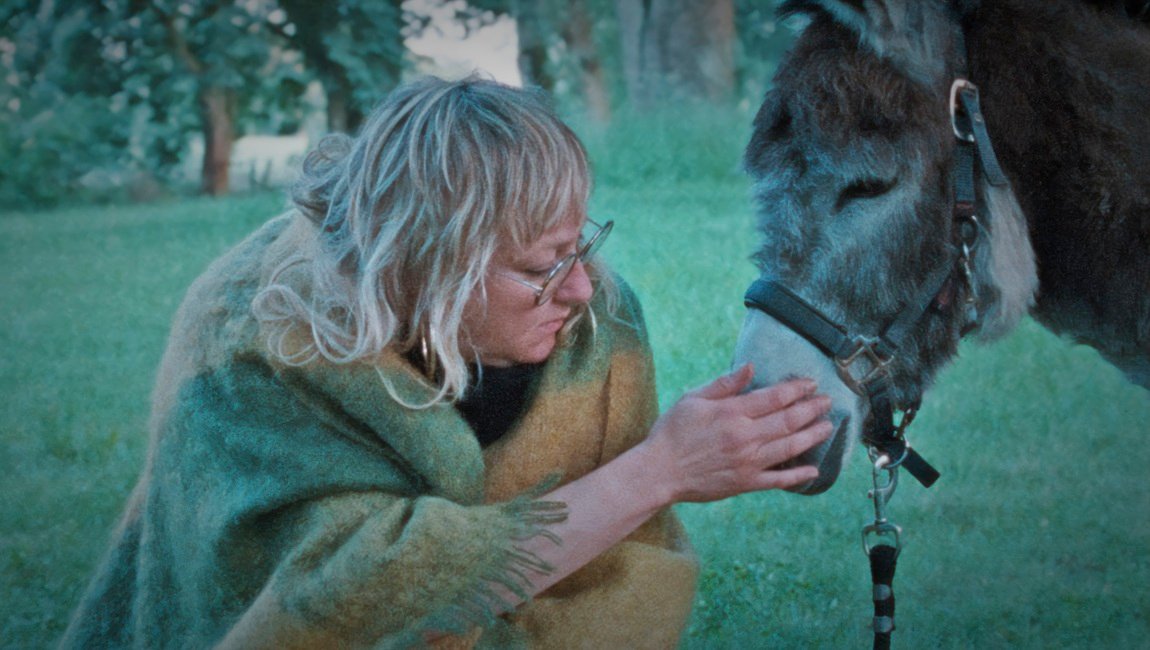
Shot on 16mm film by director of photography Aafke Beernink, Donkey Days has a grainy, abrasive aesthetic, with plenty of jittery handheld camera and tight closeups corresponding with the characters’ simultaneous emotional volatility and vulnerability. A percussive, sometimes atonal score by Ella van der Woude and fractious editing by Xander Nijsten both contribute equally to the film’s sense of emotional unmooring and free-floating anxiety. Pel further destabilizes the viewer through techniques including unexpected plot detours and excursions into fantasy that are not neatly divided from the film’s base reality. Some may see Pel’s more abstract touches as confounding, rather than clarifying, but they contribute immeasurably to the film’s rendition of family life as perpetually, palpably disorienting.
Most important to the film, though, are the performances by Krammer and Wolff, who are tasked with long scenes of dialogue and one-shot monologues, and whose characters reveal ever-more layers and complications as the film progresses. Both meet the heavy lift of their tasks as actors with absolute command and live-wire energy.
The sisters are initially presented as foils. Anna does not have the slim frame of her sister or mother and has stepped outside of their wealthy sphere of living into a more bohemian, queer lifestyle, whereas Charlotte is appearance-minded, career-driven, and anxious to please. Pel, though, puts both in situations that undercut the archetypal versions of their characters: Anna is often the more rational and emotionally disciplined of the two, whereas Charlotte tends to break down and act out in response to stressors. What both have in common is a shared struggle to contain bottled-up anger and resentment; when they do release their festering feelings, their vitriol is almost always targeted at one another, rather than at their mother.
A climactic scene of a blow-out fight between the sisters is written and staged expertly by Pel and performed with boundless energy and emotion by Krammer and Wolff. Here, Krammer plays Anna as a sneakily cold manipulator, and Wolff plays Charlotte as a reflexively defensive fighter; both devolve into shouting insults that seem to emerge from deep wells of pain. Pel has the courage of her convictions to leave the relationship between the sisters unresolved, rather than closing with reconciliation. Equally bold is her decision not to give either sister a concrete, three-act arc of growth; rather, both act out patterns of pain and manipulation that are difficult for them to recognize, much less to disrupt. As cinematically exciting as it is emotionally honest, Donkey Days will not leave audiences with comfort, but the all-too-human family at the film’s center may spark uneasy, raw recognition.
Published as part of New Directors/New Films 2026 — Dispatch 2.
Comments are closed.