
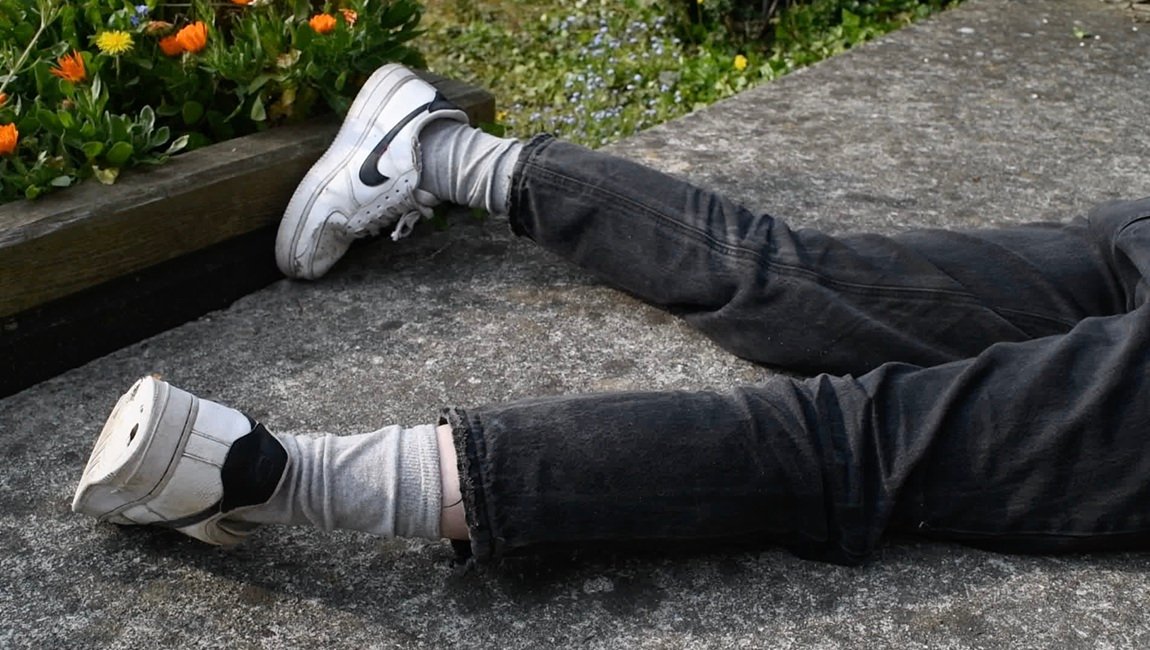
In the first half of Fantasy, Isabel Pagliai’s feature debut, it is easy to become fixated on Fatty, the Calico-mix cat who lives with the protagonist (Louise Morel). This is partly because the cat is quite photogenic as things go, but it’s primarily because the cat is the one clear figure in a film defined by slippage and fleeting coherence. We see Louise (whose name we only learn in the film’s second half) soaking in a tub while Fatty lays in what appears to be a dry, disused bidet. Elsewhere, we see Louise lying around on the floor or in corners of a dark house pierced by the occasional shaft of light. There appears to be a mattress propped up against a wall, and portions of the house seem to be crumbling. At one point, Pagliai gives us a close-up of a fire, but it isn’t clear whether it’s actually contained in a fireplace. In the glow of the embers, we can notice a pair of old tennis shoes perilously close to the flames.
In other words, Fantasy hovers around its subject, refusing to allow us to really know who she is, where she is, or what she wants. Much like certain films by Pierre Creton or Valérie Massadian, events accrue but a narrative Gestalt never forms. This sense of temporal suspension is intensified by Pagliai’s strict separation of cinematic elements. For most of the film, sync sound is not used. We hear Louise’s words in voiceover, disconnected from her body. The effect resembles Marguerite Duras’ unique use of sound, particularly since Louise’s stream-of-consciousness dialogue in no way illustrates the static events we’re observing. We see Louise writing in a notebook, and pages of this notebook sometimes appear onscreen, so these words are obviously issuing forth from Louise, but in a disjointed manner.
The film’s second half introduces a second character, Thomas (Thomas Ducasse). The two of them are in the woods, and we see their bodies in proximity to each other as they talk with one another. Thomas asks Louise what parts of her body disgust her. Their conversations are intimate, but not overtly so. Pagliai offers us the suggestion of an unplaceable sexual tension, as if Thomas wants to carefully signal his attraction to Louise without frightening her, and Louise is gradually accessing her desire for another person. This sequence serves as a conceptual bridge between a passage in part one, in which Louise details her very specific masturbation habits, and the conclusion, when she recounts having been traumatized by a deeply unpleasant, only somewhat consensual sexual encounter.
Pagliai is a cinematographer, having previously worked with Maureen Fazendeiro, and she shoots Fantasy with a remarkable attention to textures of darkness and a painterly chiaroscuro that strongly recalls the work of Pedro Costa. There are sequences that unfold in complete darkness, while others, such as a scene of Louise and Thomas in the woods, are only intermittently lighted by the flick of a cigarette lighter. Very much in keeping with Fantasy’s narrative intangibility, Pagliai applies a visual sfumato that holds bodies and objects tantalizingly before the viewer without ever permitting total possession. This is in part a film about frustrated desire and the instability of identity, a film some will no doubt find a bit too emotionally withholding. But if you are able to get on its wavelength, Fantasy is one hell of a first date.
Published as part of New Directors/New Films 2026 — Dispatch 2.
Comments are closed.