
When you see a lot of movies at film festivals, you begin to notice certain patterns in the cinema as a whole. One such pattern is that debut features are often overstuffed, containing more ideas than can be clearly articulated. This should come as no surprise. Music critics often remark that bands spend many years figuring out their debut albums, and so they sometimes possess a sprawling energy that the sophomore effort cannot always match. In film, though, debut features frequently display a tendency one might call “emptying the notebook.” When you manage to scrape together the funds to make that debut feature, you realize that you may never get to make another. So any and every idea can feel like something that simply has to be in there, coherence be damned.
The River Train is the debut feature by the Argentine duo of Lorenzo Ferro and Lucas A. Vignale. Ferro is perhaps best known as an actor. He starred in Luis Ortega’s 2018 film The Angel, which garnered significant notice. In its scant 75 minutes, The River Train seems to lurch from idea to idea, introducing themes and characters that never really carry through the film as a whole. In fact, the prologue to The River Train appears to set up a very different kind of film, only to abandon it abruptly. This may have been the point, but the results are jarring nonetheless.
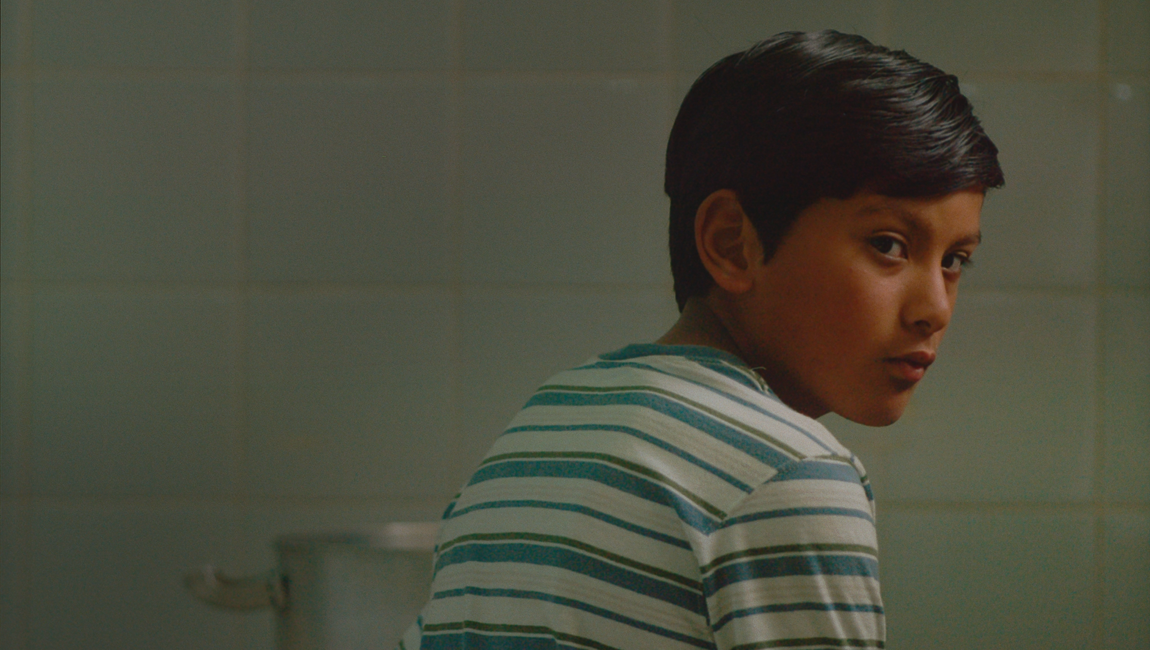
Milo (Milo Barria) is a nine-year-old boy living in northern Argentina. In the film’s best scene, we see his father Mariano (Mariano Barria) subjecting him to rapid-fire questioning that appears to be some kind of mental game. Mariano tells his son, “don’t think, speak,” over and over again. Each time, Milo responds with a random word-association reply: “moving,” “conquest,” “valley,” “watermelon,” “punishment,” etc. After this, we see Milo and three other boys participate in a dance contest, where they perform the traditional Northern step-dancing known as malambo. The dance is notable for its speed and vigor, a sort of rhythmic clogging that combines pageantry with a very masculine forcefulness. It’s clear soon enough that Mariano is the one pushing Milo to perform and compete. The dad is fairly aggressive with his son, even waking him up in the night for an impromptu rehearsal. Afterward, Milo tells his father, “good night,” to which he leaves without responding.
In an extended scene in the family home, Milo is entrusted by his mother (Lucrecia Pazos) to stir the stew they’re having for dinner. Milo doses the stew with a sleeping medicine he got from a friend at school. His parents and older sister (Mailen Barria) all fall asleep at the table, at which point Milo exits and boards a train to Buenos Aires. The boy is free, it seems, but it is unclear from what exactly. Milo then proceeds to have a very haphazard adventure in the city. He ends up in a flophouse with two grown men (Fabián Casas and Pehuén Pedre), one of whom tells Milo to go to an audition for a play. He does, and although his callback never quite works out, he does meet a young woman (Rita Pauls), whom he stalks before hiding out in her apartment under her bed. Simple questions that might occur to the attentive viewer remain unacknowledged. How did Milo pay for train fare? Did he have to pay for the flophouse? Why did he sneak into the woman’s house? And perhaps above all, how are we meant to respond to Milo’s actions and predicament?
Age play seems to be a driving force in The River Train. As a nine-year-old, the fact that he is alone in the city and staying with two strange men is cause for alarm, but the film doesn’t engage with this. Similarly, Milo’s stalking and home invasion for the young woman is presented matter-of-factly, but if he were any older, his behavior would seem very menacing. Ferro and Vignale are harking back to the classic tropes of the lone-kid-in-the-city story, recalling The 400 Blows, Little Fugitive, or The Mixed-Up Files of Mrs. Basil E. Frankweiler. But the world they have created is so hermetic that it’s difficult to feel either pity or admiration for Milo. Like the filmmakers themselves, Milo just seems bored, and wants to take in a few random sites before catching the train back home. The River Train is a scant outline of a movie, piquant but ultimately unsatisfying.
Published as part of New Directors/New Films 2026 — Dispatch 2.
Comments are closed.