
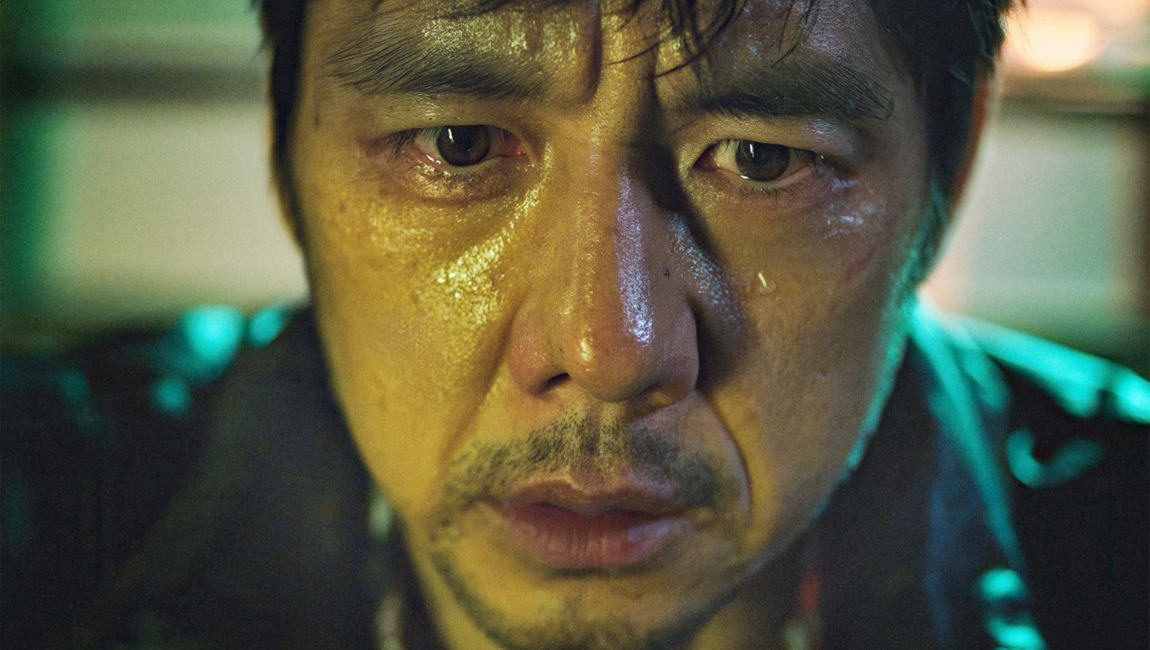
It’s the summer of 1994, and a P.I. by the name of Yonemoto (Jiro Sato) has been found brutally beaten and stabbed to death in his own home. The crime scene is a ghastly one, but unfortunately for the deceased, he was apparently so reviled in life that everyone seems to be silently rejoicing his demise; his funeral venue is half-empty, with one attendee noting that even his wife appears relieved he’s gone. Still, a dead cop is a dead cop, and so fellow Detective Mitsuo Satake (Hidetoshi Nishijima) is tasked by his superior (the great Kōji Yakusho) to find out who terminated his despicable colleague and why. Accompanying him is detective-in-training Satoko Nakano (Hikaru Mitsushima), a wet-behind-the-ears but eager-to-please novice. Their investigation of Yonemoto’s final days on earth leads them to an unsolved, nine-year old kidnapping case involving an infant born with spina bifida. As Satake and Satoko delve deeper into this mystery, they’re forced to confront their own grief and past failures as parents, unexpectedly becoming deeply and personally affected by this byzantine nightmare.
Some films can catch you completely by surprise. When The Brightest Sun commences, it bears all the hallmarks of an impossibly grim murder mystery, something akin to Memories of Murder or Se7en. The director is Tetsuya Nakashima, who made a name for himself with the vibrant sugar rush of Kamikaze Girls but also the darker and considerably more violent Confessions and The World of Kanako. For his latest film, Nakashima deliberately keeps the audience off-kilter with his achronological and elliptical editing, doling out information in fits and spurts. It’s the perfect feature to emulate the messy headspace of central character Satake, who is introduced as little more than a leather jacket perpetually swirling around the inside of a liquor bottle. He’s a man with a haunted past, begrudgingly reporting for duty before he can go home and tie off several to silence his inner demons. Satake’s withdrawn demeanor clashes with the more chipper Satoko, the partner looking to make a good impression but who only finds frustration in having to do most of the legwork in their investigation.
While the first act sets the stage for a standard-issue detective procedural, the revelation of the kidnapped child shifts the film’s priorities on a dime, softening the picture and its two detectives. There’s Tomie (Haru Kuroki), the mother of the lost child, who has never given up hope in finding him. And then there’s the discovery of Shin, a nine-year old child with a spine bent at a ninety-degree angle, who lives in a seaside shack with father Akira (Kankuro Fuji). Convinced this is actually the kidnapped child, the detectives wiretap the house, unaware that this case hits closer to home than they ever could have anticipated. For Satake, he’s forced to reckon with his own loss of a child with disabilities, fracturing his relationship with his wife and keeping his teenage daughter at a distance. Satoko was once happily married with a daughter, but a hasty moment of self-defense in an effort to protect her from her husband’s drunken bender results in her losing custody of her daughter, only able to see her during arranged visits. It’s Satoko who grows closest to the mystery of Shin, then, listening in on the wire as she grows heartened with the treatment of this child, remaining unconvinced that Akira would never do such a thing if he were actually the kidnapper.
The Brightest Sun takes pains to drive home just how difficult raising a child can be, detailing all of the exhaustion and frustration that compound when taking care of a child with special needs. Nakashima does not shy away from this difficulty, but he’s not out to lambast these families either; he’s merely presenting a detective story to share the reality of what less privileged families must contend with in order to survive. The Brightest Sun unfolds gradually but masterfully, melting its icy center to approach something more deserving of its optimistic title. There are still a few missteps along the way: the film opens with a definition of the word “repentance,” just in case any of its core themes should fly over the viewer’s head, and some will surely wholesale reject its change in tone from grim to treacly. But Nakashima works hard to keep the film’s myriad disparities cogent, delivering a largely assured work of genuine sensitivity.
Published as part of NYAFF 2026 — Dispatch 2.
Comments are closed.