
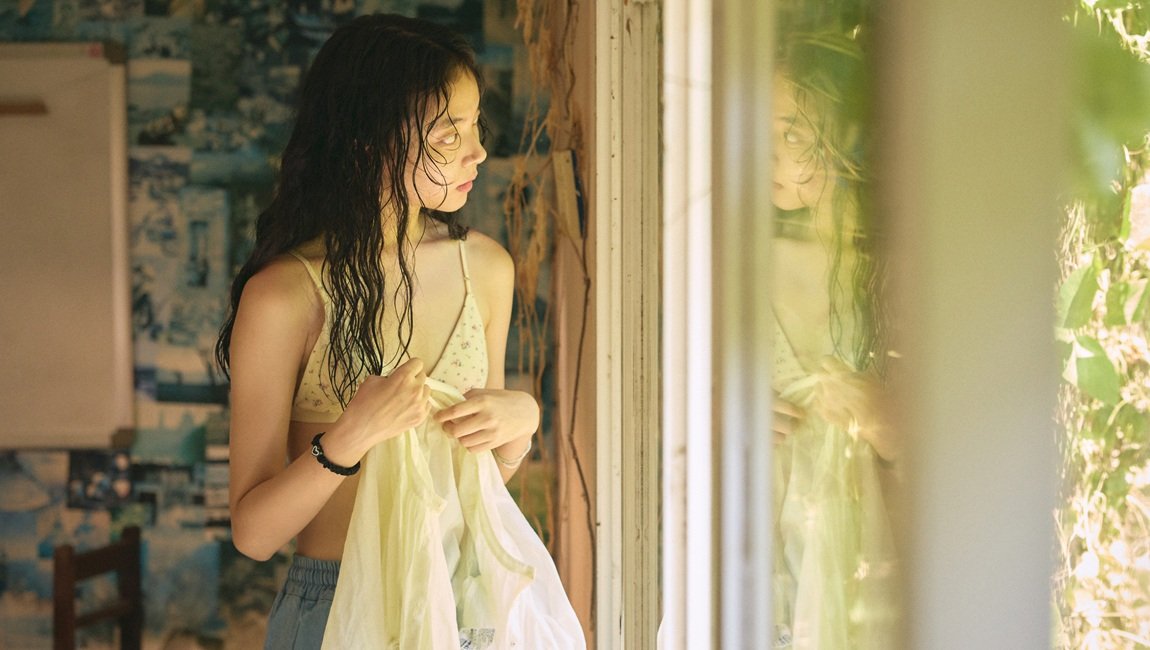
Love buds during summer on an idyllic Korean island. At least, it does for Jin (Sim Su-bin), a 17-year-old girl native to the island. Her childhood friend Dujae (Kim Eo-jin) comes back to the island after moving to Seoul. His mom, however, doesn’t show, and her absence frustrates his grief. He spends the summer occupying her empty house like a ghost, but his presence has the effect of intensifying the heat of summer for Jin.
The World Before is the third feature from director Yoon Dan-bi, and it reflects a legible continuation of her growing filmography. Best known for her first narrative film, 2019’s Moving On, which is also set during the perpetually evaporating summer season, Yoon then directed a documentary portrait of actor Lee Je-hoon (Time to Hunt), Another Record: Into the Daydream, a film where memories and dreams collide much as they do in her latest.
Jin’s infatuation with Dujae is largely symbolic of her own negotiation of self. The sparks start after a conversation with her friends, who put the two childhood acquaintances on the spot with the question all children dread: “Do you like each other?” She smiles at the idea the question conjures, imagining a near-future of them coupled in young love. But he shoots it down. “Don’t be ridiculous,” he starts, collapsing her smile. “She and I would go to the beach and run around with our clothes off,” pushing the past to the forefront. She yearns for the future; he grieves the past.
The summer Yoon conjured in The World Before is on quiet guard, with the warm light of the sun to provide her characters comfort. And it’s a world easy to fall in love in: Lee Seong-eun’s camera gracefully dances around the teenagers with its own intimate character, while the film’s sonic texture is one scored more by silence than by Lee Min-hwi’s subtle compositions. When the music is perceptible, her score carefully moves as if to make judgment. Take, for instance, a flirty shared bike scene where Jin tries to sit on Dujae’s handlebars, but they struggle to make it work and crash before even setting off; she ends up on the back of the bike, holding onto his waist so as not to fall, and Lee’s ethereal score transports us as if into a fairy tale.
The World Before centers both female desire and female heartbreak. Unrequited or unevenly requited love on film often flows in the other direction, but here it is a woman whose feelings go unreturned. This emphasis extends to Lee Seong-eun’s female gaze-reflective depiction of sensuality, where hands, lips, and reactions take precedence over exposed skin and voyeurism. A scene of Jin approaching the obfuscated shower door, where Dujae (not knowing Jin is even in the home, and thus non-consenting) stands completely in the nude, seems to make a point in rejecting patriarchal voyeurism with a sharp edit, one which moves Jin from standing outside the door’s privacy glass to sitting on the floor, waiting for him to finish.
Present Jin’s attraction to present Dujae is a dynamic born from a combination of post-puberty desire, the time they enjoy together, and the comfort of their intertwined pasts. The world is small on the island, and so too are Jin’s romantic prospects. She doesn’t like the thought of him being with other women, but these interactions always come with the additional baggage of “other girls… in Seoul.” If Seoul shares some relationship to the future, where students leave for college and lost lovers hide, the island holds onto the past. Front doors stay open to the whole community through the day, and everyone still knows everyone. This is even told through the geographic positions of their houses on the island: Dujae stays at the top of the hill; she lives downhill. Perhaps a play on the title, The World Before appears set in the present, though there is a resistance to depicting screen technology. Bored characters read; they don’t doomscroll; Dujae finds his dead grandma’s diaries and reads them noisily as she entrusts her disappointment with married life on the island to the pages of her journal. He may enjoy spending time with Jin, but his past — symbolized by the island and his grandma’s memories — holds him hostage.
The only assured truth about summer is that it always comes to an end. The love wasn’t entirely unrequited, and Dujae’s departure for the mainland via boat demonstrates this in images alone. There is no final screaming declaration, nor any grand romantic gestures; those would be alien artifacts in The World Before. Instead, as Jin sets her gaze on the departing boat as it cuts through the sea, Dujae, from the back of the vessel and on the far left of the frame, as if trailing the camera’s gaze, looks back to the island. They look past each other — Jin to the right, Dujae to the left — as if their looks alone might connect a timeline between them: past and future.
Published as part of TIFF 2026 — Dispatch 3.
Comments are closed.