
Hong Kong cinema is dying, or at least so says the BBC (https://www.youtube.com/watch?v=IQd3BiwYM1E). But keen observers will note that Hong Kong cinema, like cinema itself, has always been dying. The latest crisis may be more serious than most, and certainly things look bad compared to the industry’s peak in the early 1990s, but narratives of decline tend to overlook the fact that vibrant and exciting works are emerging from Hong Kong every year, and that an industry that’s reinvented itself through a half dozen crises over the past 60 years is in the process of doing so once again. There are fewer films made in Hong Kong these days, but nowhere else in the world would a young filmmaker imagine their debut feature as the Netflix series Beef meets Hamaguchi Ryusuke’s Drive My Car. That’s exactly what Yeung Leung Chuen has done with We Are Born Good.
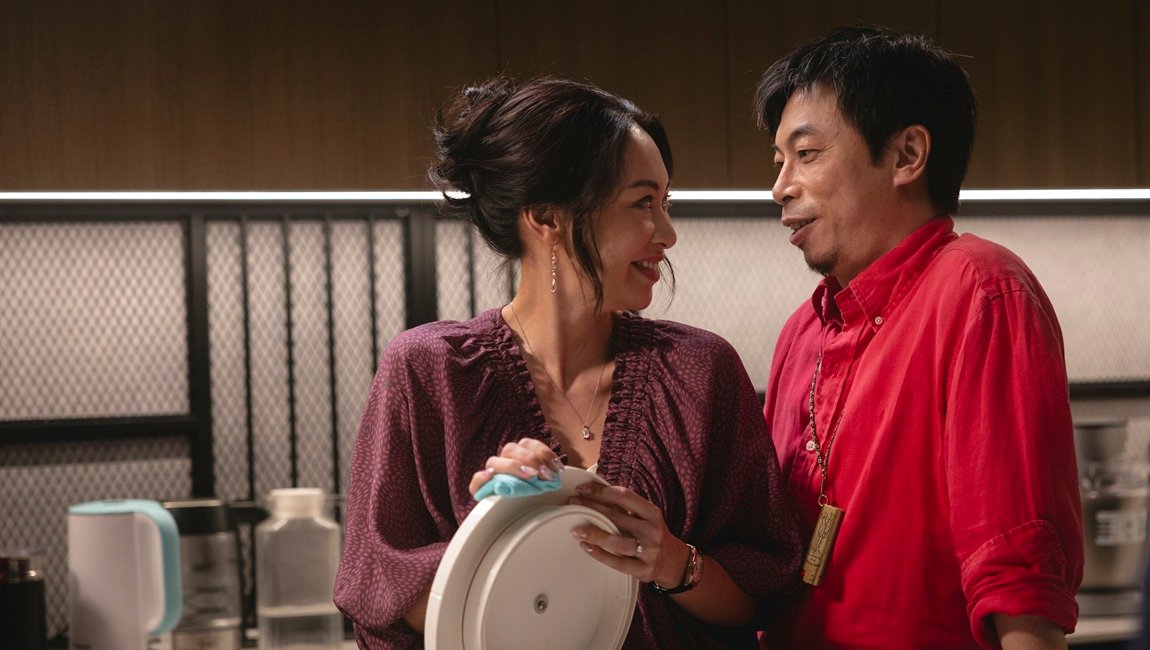
Chung Suet-ying (star of Norris Wong’s The Lyricist Wannabe) plays an aspiring actress who is forced to stay late at her job at a clothing store and almost misses an audition. She makes it and ultimately gets the part, but exhausted from a long day, she orders some takeout on the way home, only to find that her Singapore fried noodles have been replaced by beef chow fun, and she doesn’t eat beef. She walks back to the now-closed restaurant and confronts the owner (Yeung Wai-lun), who apologizes but explains that he’s closed and can’t make her the proper food just then. She eventually leaves in anger and disgust, returning sometime later for revenge in the form of letting roaches loose in the store and flooding the bathroom.
From here, the prank war escalates — he puts her picture and phone number on sex websites, she graffitis his walls, etc. — while Yeung builds out the characters’ worlds. The restaurant owner is the black sheep of a successful family, having served time in jail, and his restaurant is funded by his younger brother, a doctor. The actress, meanwhile, is thinking about getting an apartment with her girlfriend, but is also developing a friendship with the writer (Kearen Pang) of the play she’s starring in, an older woman who has a romantically tragic past, one which intersects both with her play and with the young actress’s life.
The theatre scenes, the relationship between performance on stage and in life, as well as the fact that the writer is partially deaf, are all beats that owe an obvious debt to Hamaguchi’s hit. But Yeung doesn’t overplay the homage, instead offering balance via the more class-forward elements of the restaurant owner’s story, linking the aspiring actress and the ex-con as failures in the eyes of respectable, success-focused Hong Kong, people left behind by the city’s all-powerful strivers. Their prank war is the hook that links the two characters narratively, but its importance fades as the film instead becomes a character study, with those characters themselves becoming a stand-in for Hong Kong itself.
The Slobs vs. Snobs construction has a long history in Hong Kong cinema, with the slobs standing in for the polity itself. Whether as a colonial outpost, pawn of international negotiations, or special administrative region, Hong Kong has always been on the margins, the black sheep of empire, relentlessly committed to doing its own messy and improvisational thing despite the desires of the controlling powers that it simply clean itself up, follow instructions, and get a real job. The stresses of the 2020s pit the actress and the cook against each other, fighting a pointless war until they slowly realize the real enemy is not each other, but the rich and successful people who toy with their lives, manipulate them, and then blame and discard them when things go awry. There the perennial hope of solidarity lies, for our heroes, for Hong Kong, and for its cinema.
Published as part of TIFF 2026 — Dispatch 3.
Comments are closed.