
Here’s the thing about competitive drift racing: it has very little to do with who crosses a finish line first. Instead, it’s a pastime focused on execution, the precise control of the car as it accelerates and decelerates, and the fine calibration of momentum. In that sense, Drifter has taken plenty of inspiration from the sport it depicts. Unfortunately, the film’s momentum hasn’t been as finely calibrated. Clearly a labor of love, it nonetheless falls into repetition and cliché even as it more successfully indulges in the languid beauty of the car in motion.
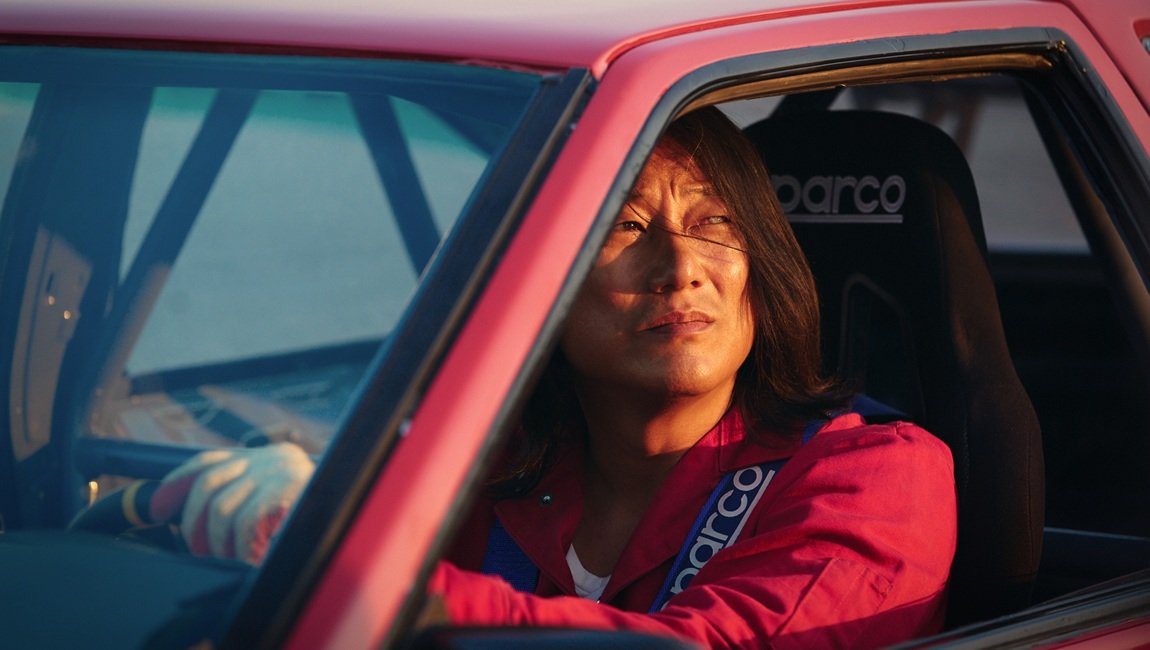
Sung Kang (also directing here) is Tree, who spends his days cleaning up at an autoshop/racetrack in dust-ridden Barstow, California. In his off hours, though, he drifts, wrapping his gorgeous (but slightly banged-up) vintage crimson red Toyota Corolla AE86 around the loops of a deserted obstacle course. Blind in one eye and beset with PTSD from a traumatic childhood, Tree has no real relationships to speak of beyond a loose circle of losers who also populate the track. But when a simple twist of fate offers Tree the opportunity to compete in a professional drift competition, he snatches the chance, though he doesn’t yet understand that he’ll have to open up to help, both technical and emotional.
Drifter is an obvious passion project for Kang. An outstanding supporting actor who propped up some of the best of the Fast and Furious films (in which he is a fan favorite), he never got his due as an action star or leading man. That’s too bad, because he can deadpan with the best of them while still feeling like there’s a reservoir of feeling that exists deep down. As a performer, he serves his film well here, making Tree’s stoicism always feel natural, soulful. And he’s populated the film with an appealing group of friends from his acting school days, like Tamara Braun’s Rosie, who takes a liking to Tree, and Gregory Cruz as a drug dealer, though his thread offers a rather unnecessary crime subplot that simply bloats out the film.
Speaking of, let’s talk about the runtime, which lands at an astonishing 147 minutes. In fairness, the best parts of Drifter are spent watching Tree in his beautiful car as it coasts through loops and sails around the track, sequences that are superbly shot and loaded with arresting images, especially for aficionados — you could watch hours of it. But the melodrama that takes up the space in between racing sequences is unfortunately merely rote. And in such large portions, too! There are at least three scenes where Tree dances with Rosie at Golden Hour, as well as endless chatter with racing mentor Bennett (Michael Nehring), who does the standard gruff old-timer routine while battling through tears to talk about his dead-too-young daughter. Kang’s intent here is sturdy: build a community of down-and-outs and have them rally around a beacon of hope (in this way, Drifter is eerily reminiscent of Shûji Terayama’s 1971 film Boxer). This all works great on paper, but in practice it simply drones on and on, doling out monologues and repeating character beats ad nauseam. Much like the sport itself, stripping out what doesn’t matter and focusing on execution should have been the goal. At a leaner 90 minutes, Drifter would have been an outstanding, idiosyncratic sports drama. Viewers will need to decide if the extra hour of bland emotionalism is worth the effort.
Published as part of TIFF 2026 — Dispatch 4.
Comments are closed.