
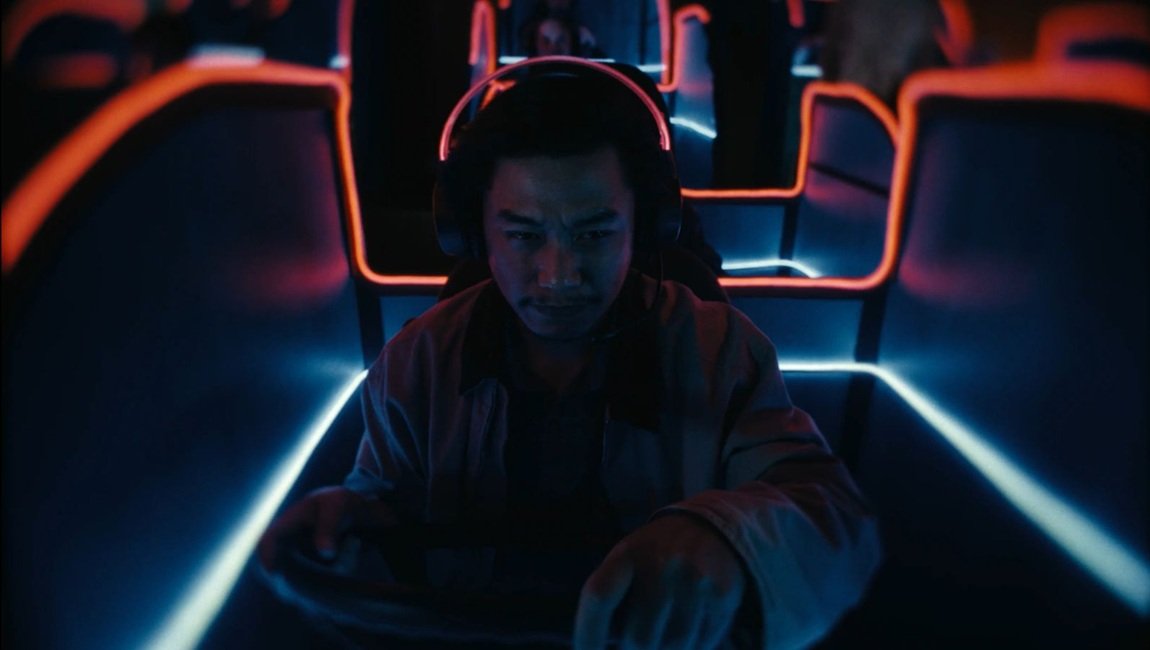
“Is there even a suspect? Is there even a crime?” These words spoken by Detective Mijares (Alchris Galura) are as good a summation as you’re likely to find of The Remotes, the sprawling and bizarre new film from Filipino director John Torres. Expanding on his highly experimental approach, seen in previous films such as Toro Toro Teros (2006) and Lukas the Strange (2013), Torres has produced one of his most ambitious films, a 150-minute mood piece that sustains a tense techno-noir atmosphere without ever settling down into a linear plot. The Remotes can be, well, frustratingly remote at first, as the viewer struggles to understand exactly what is happening and why. But gradually we let go of this need to know, and if you can simply succumb to its pervasive mood of oneiric menace, the film begins to wind itself around you.
In short, this is a film about confusion, about the shifting nature of what it even means to be a human being in an uncertain world. With its sleek surfaces and permanent-midnight color palette, The Remotes can be seen as a distant cousin to Blade Runner. The aforementioned detective is trying to get to the bottom of a series of increasingly violent and random automobile and motorcycle crashes. But as Mijares becomes increasingly mired in the secrets of this dreamlike version of Metro Manila, he becomes compromised. At least that’s how we’d understand it in the typical language of film noir. In fact, he may simply be discovering that letting his identity be absorbed by unseen forces is an altogether more satisfactory outcome than trying to solve the puzzle. It seems Torres is inviting us to do likewise.
Here’s what we know. There appears to be a connection between the fatal crashes and a new phone app that is shared among users like a secret handshake; or, better yet, a virus. This app invites the user to relinquish his or her control over their own body. In essence, the app “drives” the user, sending them in directions and onto tasks that exceed the individual will. Mijares begins to suspect that two sisters, Eva (Julia Richards) and Gill (Gabby Padilla), may be at the center of this mystery. Both sisters work in fields that involve turning themselves into digital content. Gill records the voice for a GPS system, while Eva records real estate walkthrough videos. And both seem to be involved in a driving safety school that resembles a cult. While the sisters are still mourning the recent death of their mother, Mijares is still grappling with the death of his wife Marie, from “natural causes” that begin to seem less and less natural.
Torres’s sonic and visual language is entirely unique but not without precedent. In certain moments, The Remotes seems to touch on the urban alienation and vaguely supernatural atmosphere of Apichatpong Weerasethakul, Tsai Ming-liang, Kiyoshi Kurosawa, and later Hou Hsiao-hsien. But the closest kinship is clearly with Chinese director Bi Gan, as Torres is far more concerned with communicating modern life as a kind of all-consuming pressure or affect that exceeds language’s ability to articulate it. Characters’ trajectories shift and mutate, people seem to switch identities, and it is difficult to see how we get from one place to the next. In the world of The Remotes, the general state of being is a combination of grief and amnesia. Ghosts do not walk among the characters, in the manner of Weerasethakul, but the hovering oppression of previous generations impedes motion and personal choice.
The main aspect of The Remotes that will thrill some viewers will leave others deeply frustrated. The film thwarts ordinary meaning-making, and it seems to invite some sort of allegorical interpretation. Torres never specifies what this loss of free will represents, but the film is capacious enough to accommodate many different readings. Its use of GPS as a guiding metaphor can perhaps be understood as a statement on how we have given up free will in order to be “driven” by technology. People in this film behave like non-player characters, waiting for instructions from the unseen player. Critic and Remotes fan Sam Bordojan has suggested that the steady accumulation of dead bodies, a situation to which almost everyone but Mijares has become numb, could be seen as a metaphor for the Duterte era, with its rampant extrajudicial killings. Both interpretations seem entirely plausible.
But above all, The Remotes is a formal experiment that enacts its own premises. If you try to occupy the driver’s seat, this film will take you places you probably didn’t want to go. If you give yourself over to its rhythms and just ride with it, you still may not reach your desired destination. But you won’t for a minute doubt that you’ve gone to a place you’ve never seen before.
Published as part of NYFF 2026 — Dispatch 4.
Comments are closed.