
The magic of the digital world allows us to be instantly and perpetually connected with one another. Childhood friends, high school crushes, former co-workers, distant family members — we all have the means to keep in touch, no matter where we’re located on the planet. But this can be something of a double-edged sword: since our online identities are completely self-manufactured to our liking, how much of our real selves are we genuinely putting out there? Can a digital avatar accurately reflect the true individual if it’s an ultimately warped personality that only shares the more favorable aspects of one’s life? That’s just one of the many questions that writer/director/producer/cinematographer/editor Joshua Z Weinstein poses in Here I’m Alive, his first feature in nine years after 2017’s Menashe. Spanning the course of a single evening in The Big Apple, Here I’m Alive centers around fewer than a half-dozen New Yorkers who run the gamut from social media influencer to escort to gig economy worker to migrant to shut-in, each of whom is addicted to the screen in their pocket. Despite its scant runtime — 75 minutes before credits — Weinstein captures his subjects with stunning, neo-realist intimacy, delivering a micro-budgeted, semi-fictional, anthropological mosaic about The State of Things.
The film’s striking opening shot is that of a heavily pixelated computer screen, distorting the image to an unrecognizable degree while the garbled audio follows suit, recalling even the harrowing introduction of David Lynch’s Twin Peaks: Fire Walk with Me. The soundscape clears up first, revealing the source to be a YouTube interview with Silicon Valley venture capitalist Marc Andreessen, happily waxing optimistic about the possibilities of digital technology. The billionaire’s thoughts are punctuated by the chime of Discord chat notifications, originating on the computer of Majora (Cheyenne Gallagher), an agoraphobic young man who sees little reason to leave the comfort of his apartment, preferring to socialize with the like-minded individuals of his online forum. Elsewhere, social media influencer Emira (Emira D’Spain) is gearing up to celebrate her birthday party online, rehearsing how to best greet her followers while working through her extensive make-up routine. There’s also Felix (Caleb Zuzga), who himself is currently undergoing lip filler injections in the hopes of wooing a sugar daddy on his LGBTQ dating app. And then there’s Krystaly (Krystaly Figueroa), producer of a new online Flavor of Love-esque reality dating series, laser-focusing her efforts on making this her big shot to online stardom. Rounding out the core cast is Eddie (Eddie Torrenegra), a Venezuelan delivery migrant worker who hopes to bring his children stateside one day, but in the meantime must keep his head down and do his job lest any of the plain-clothed ICE agents scoop him off the streets.
With only a handful of largely non-professional actors to work with, Weinstein effortlessly weaves through the lives of his characters, bouncing from one story to another and occasionally intersecting his players as they pass each other through the night. The throughline here is the internet writ large, wielded by everyone as a means to improve their lives and livelihoods. For Eddie, FaceTime calls offer a direct link to his children, whom he wants to be able to bring into the country to live with him one day, while his social media consists of him boasting about how great life is while driving his fancy orange sports car, when in reality he’s bribing the vehicle’s actual owner to film himself standing near it. Krystaly’s also in a bad spot, ignoring the guidance of her occupational caseworker by neglecting gainful employment working at Target, instead channeling her efforts into making her TikTok reality series a hit, auditioning men to be the potential suitor for the online celebrity host. Felix is searching for a more personal connection, altering his body and heavily utilizing ChatGPT to respond to offers for dates with older men, yearning for one to be his next meal ticket. (This is not the only reference to AI — a fleeting message board user posts that he prefers ChatGPT to a real-life therapist, in case anyone wondered how bad things are out there.) But perhaps most compelling of all is the saga of Majora, a portly lad who has all but rejected the outside world in favor of the World Wide Web. There, he becomes embroiled in the personal life of the latest member of his chat forum, a dejected and suicidal young man, spending the bulk of his plotline figuratively talking him off a ledge.
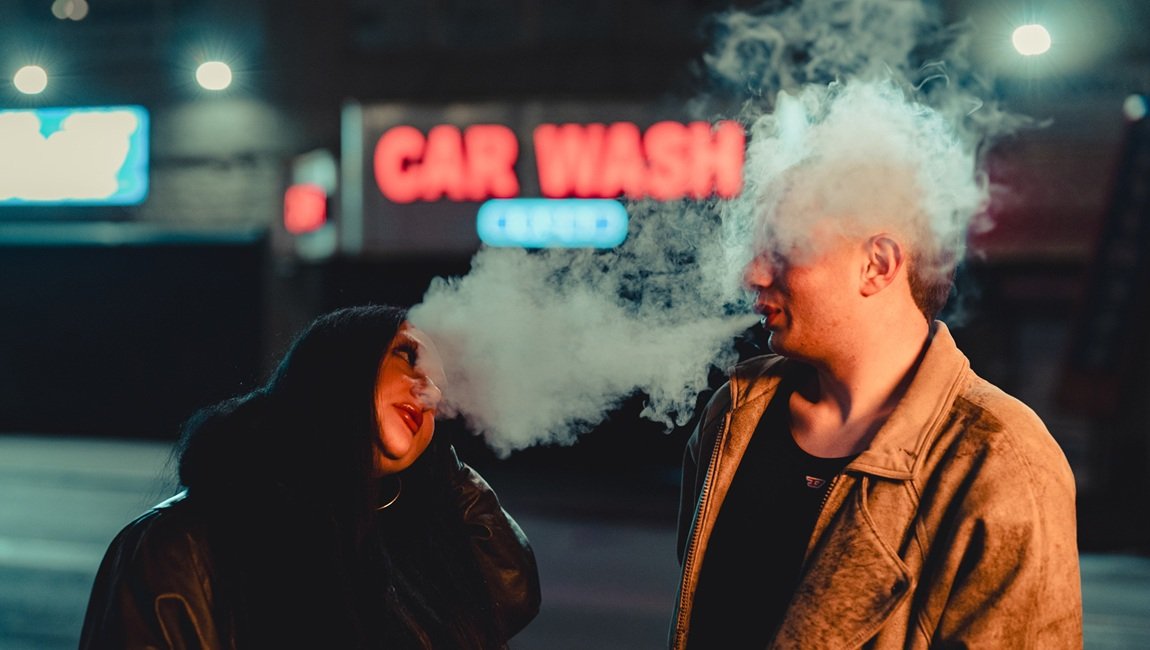
Suffice to say, the world is not in a great place right now and Weinstein knows it, but he’s not out to judge, mock, or ridicule those who are trying to make a difference. The title of Here I’m Alive can refer to the thriving cyberspace where one can make their escape to and feel most fulfilled when the alternative of reality offers nothing but cruelty and despair, but it’s also a defiant message to the punishing system that deliberately brings people down, as if one is giving the finger to the powers that be for surviving their endlessly harsh machinations. Weinstein captures the depth and complexity of living online in a cinematic microcosm, which features some gorgeous photography of The City that Never Sleeps during its darkest hours, showcasing a symphony of city lights and activity. The film’s ending does wind up landing somewhere more conventional than the rest of Weinstein’s project, but for most of the runtime it’s a compact, beautifully-realized tapestry of a handful of New Yorkers merely trying to get by.
Published as part of New/Next Film Festival 2026 — Dispatch 1.
Comments are closed.