
Riptides is a dark comedy about a simple man who, inspired by the words of a self-help author, tries to revolutionize his life and ends up showing how the blind pursuit of success can be destructive. In a film that exposes the deleterious effects of compulsory ambition, Alex Karpovsky uses the world of influencers to expose the hypocrisy of an impossible lifestyle that imposes ambition as the sole mark of success in a man’s life.
Toby (Steve Little) is the caretaker of a beachside hotel on the coast of Sayunita, a fictional town in Mexico, where he lives and does minor repairs for guests. We are introduced to Toby’s contentment with his unluxurious life. He enters the ocean with his bodyboard, chats with his friends while wearing flip-flops, an unbuttoned beach shirt exposing his sizable abdomen, and baggy below-the-knee shorts. At the end of the day, he is content watching the sunset while smoking weed and masturbating alone in his single-room bungalow. Toby is happy being Toby. In the eyes of the Meltons, newly arrived guests, Toby is nothing more than just another loser. Paul Melton (Dylan Baker) is a self-help author who built a career teaching that happiness and purpose are antagonistic and that a truly successful man must be strong to leave his mark on the world, ready to take flight. Michelle (Bojana Novakovic), his daughter, is responsible for managing him and running his social media.
Karpovsky abruptly shifts from the sunny style and slapstick tone he uses to establish Toby early in the film into a graver register. The soundtrack also becomes heavier, creating contrast in the father-daughter relationship. Toby seeks advice from his friends to treat testicular pain from scrotal trauma caused by his bodyboard, while the camera focuses on his cream-covered hand applying it inside his wet shorts. We cut to Paul emptying a bottle of vodka after being forced to record a sequence of countless stories for the speaking tour promoting his latest book, Leave a Mark. Paul faces the sunset with a somber expression and contemplates the sea at length, while the camera frames him from behind, showing his aging neck and crooked posture. He gets up from the ground, and the camera follows him as he walks into the sea.
For nearly the whole film, Little plays Toby as a man who seems to have some difficulty understanding his social situation. His speech is slurred, projecting his voice from the back of his throat as if he were hiding a potato in his mouth, which operates as a shortcut to establishing an exaggerated naïveté that might produce some degree of sympathy and humor. And in his behavior, Toby reinforces adolescent behaviors in a white-haired man, spending a great deal of time describing a bodyboard with a hole for male genitalia, believing this will revolutionize the world, without realizing that the other characters receive everything he says as nonsense. The resulting energy is that of a man easily manipulated by well-crafted rhetoric or a woman’s beauty — which indeed happens throughout the plot.
Riptides lets subtleties be washed away by the tide: in the very first dialogue between the characters, Toby is already confronted with the statement that his life has no meaning. From that point on, the script forces the character to become a voracious consumer of Melton’s bitter life philosophy, without sufficiently developing the transition from the initial shock to obsessive adoption. An exchange of two or three sentences is enough for him to start devouring his audiobook. In this way, Riptides is quite cruel to its protagonist. The script agrees with Paul, because even before he arrives at the hotel, Toby is already presented as an object of mockery simply for being a harmless idiot satisfied with his own life. And by characterizing the quiet caretaker’s contentment as the result of his naïveté, the film weakens its critique of Melton’s self-help model.
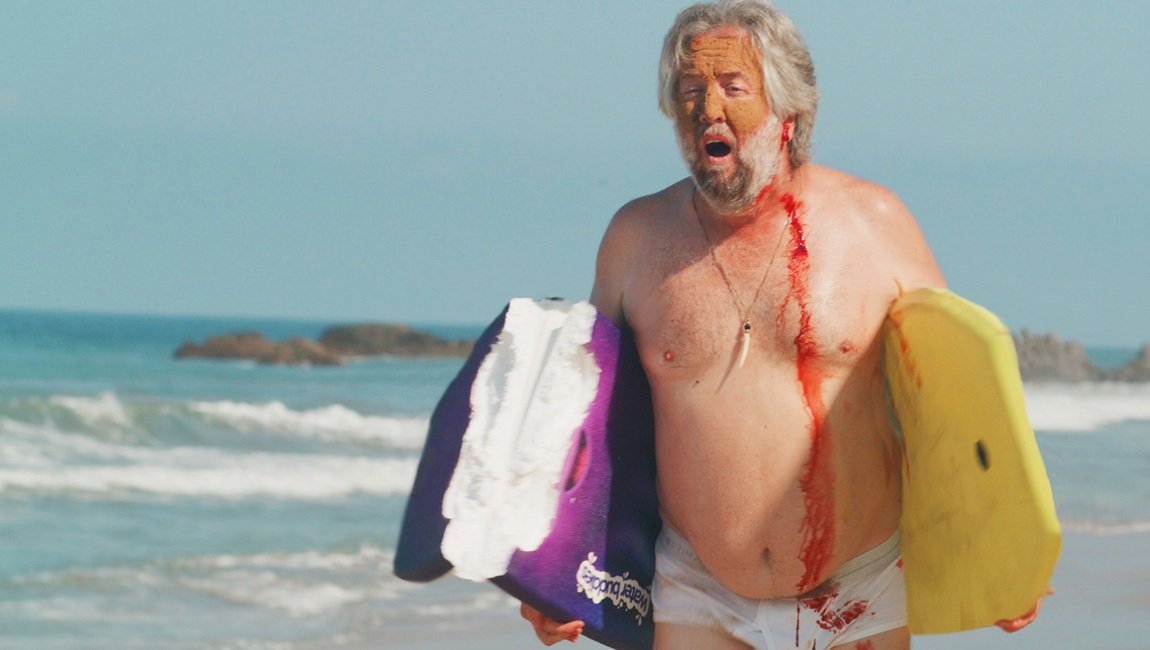
This sharp contrast between the characters also has the effect of making it seem as though the actors are in different films, even while sharing the same screen time. Little plays it like a Dumb and Dumber remake; his performance pushed toward comedy even in moments when his character is frustrated or mistreated. When they threaten to steal Toby’s boards, he defends himself like a child, terrified, holding onto one of them almost defenseless, before clumsily running away clad only in his underwear. His pain becomes yet another occasion for mockery, as the film shows no interest in portraying Toby’s humanity or complexity in the face of humiliation. Novakovic, meanwhile, feels like she is in a family thriller, serious and concerned, as she attempts to conceal the charade of her father’s empty life, trying to maintain the rigor and morality of a life deeply marked by depression. Inevitably, whenever these performances, marked by contrasting voices and facial expressions, collide, the film’s tone suffers the whiplash of collision as well.
Perhaps to make up for these deficits, Riptides takes pains to add more dynamism by constructing certain narrative passages or character flashbacks using visual devices. The most interesting, by far, is the integration of recognizable social media elements. Karpovsky’s film introduces characters through their Instagram profiles and uses stories and posts as a narrative device embedded in the photos of a feed, a choice that is both organic and logical, since a large part of the script’s argument rests on the ambivalence between the life lived and the life preached by social media figures. We see an eschatological scene of the character narrating how he scared away a restaurant’s famous clientele through an influencer’s disapproving stories, while simultaneously drawing the owner’s wrath upon himself. Despite the bizarre content of the narration, the entire scene is effectively energized by the switching of phone screens.
Other visual strategies, however, are less successful. In the film’s few scenes of violence, its blood has a distinctly artificial look and texture, and follows implausible trajectories given the angles of the blows struck. Perhaps a minor gripe to pick, but it has (unintentional) comic consequences and creates a strange distancing effect in the viewer. Elsewhere, the film’s dream sequences likewise land with less impact than intended, using a hazy filter that seeks to evoke the dreamlike, but ultimately ending up repetitive, even when replayed in slow motion during frenzied fantasies where the character revels in the glory of his completely stupid project. In this way, Riptides insists on showing everything we already know about its protagonist, reinforcing the idea that his ambition and self-image are as empty as his actions. Toby shifts from contentment to obsession, but the film’s visual design does nothing but double down on what has already been made over-explicit through its unsubtle character development. In the end, we are left only to observe the death of contentment without any accompanying grief, all dramatic weight becoming merely another detail in the caricature of a subject who was established as ridiculous right from the start.
Published as part of New/Next Film Festival 2026 — Dispatch 1.
Comments are closed.