
The 2026 Toronto International Film Festival seems intent on making lightning strike twice. Last year, Obsession went from a Midnight Madness premiere to one of the most profitable films of all time, while John Early’s Maddie’s Secret went from a tucked-away Discovery title to an unlikely summer smash. With the inauguration of TIFF’s Market, it’s tempting to measure the festival’s success by the size of its acquisitions and the headlines they generate. But that kind of thinking ultimately serves the pockets of festival shareholders more than the artists who worked tirelessly to have this moment. And one thing about Missouri-born comedian Caleb Hearon — he is having a moment.
Hearon has quickly ascended by riding a recent wave that includes a successful stand-up special for HBO, an ever-increasing presence on social media through his podcast So True, and appearances in summer blockbusters like The Devil Wears Prada 2 and Trash Mountain, his first starring role in a film. Co-written by Hearon and Ruby Caster (Bleeding Love), and loosely inspired by the death of Hearon’s own father, Trash Mountain follows Gavin, a Chicago transplant originally from the Midwest who works as an emcee at a drag bar and who, in the week leading up to Thanksgiving, gets a tearful call from his half-sister Abbi (a charming Zooey Deschanel) that their hoarder father has succumbed to his alcohol addiction. Now he must return home to help arrange the funeral and sift through the wreckage of their family home in order to find his father’s Social Security number.
One thing the film makes abundantly clear is that if you don’t have a plan while in the Midwest, the Midwest will make one for you. Gavin’s grandmother, Helen (Jackie Weaver, in a thinly fleshed-out role), is adamant that the local pastor should oversee the proceedings even though neither the deceased nor his kids were religious, and seems to be carrying the burden of grief that neither of her grandchildren seem particularly interested in performing. There are also the questions of Jerome (equally popular comedian Jaboukie Young-White), who keeps hitting up his phone for late-night hookups, and the ever-growing pile of trash outside his late father’s front lawn. It would seem that Gavin’s plans to escape back to the city in time for Thanksgiving are growing increasingly unlikely.
Director Kris Rey — a co-creator of the web series Young American Bodies with ex-husband Joe Swanberg and a director on Lily Wachowski’s criminally underrated Showtime series Work in Progress — has elsewhere demonstrated a knack for calibrating distinct comedic rapport out of her ensemble, and that holds in Trash Mountain. Hearon and Deschanel, in particular, operate as the easy heart of the film, not only on the strength of their effortless back-and-forth, but through their believable portrayal of shared dissatisfaction with having a parent whose addiction has tainted even their fondest memories. As the romantic interest, meanwhile, Young-White’s every small attempt to tease Gavin catalyzes the viewer’s glimpse into Gavin’s defenses, the product of having grown up bruised enough by his relationship with a troubled father. Through all this, Hearon and Caster’s screenplay correctly recognizes that veil of humor as a coping mechanism.
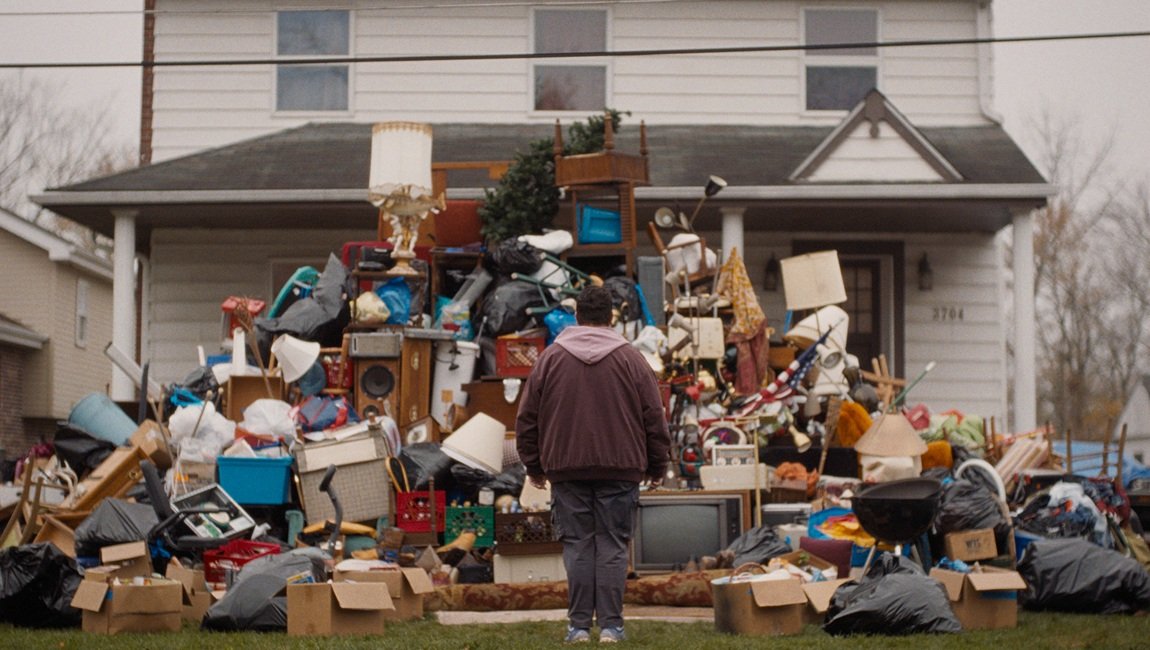
Befitting a film called Trash Mountain, production designer Matt Hyland was dealt a massive undertaking. The construction of Gavin and Abbi’s childhood home is well-realized, not only authentic as the dwelling of a late hoarder, but also as a sort of mausoleum to the wreckage of a childhood that the viewer can never fully understand. Trash Mountain’s preoccupations lie in detailing how thorny our relationship to our own material origins can be — even as thorny as to the people who were there. This emphasis on locating details within the familiar extends even to the economic landscape of this small Missouri town: Young-White’s character has a well-paying job and enjoys his life and cheap mortgage in the Midwest, but Gavin’s loving brother-in-law (played by Kyle Marvin) frets over mounting debt and the rising cost of living. Credit also goes to the film’s development of a welcome and complicating depiction of Midwestern conservatism, where labels don’t matter so much as behavior. Gavin’s father, for instance, wasn’t a bigot, and in fact is described as having been fully accepting of his son’s sexuality, but their conflicts stem more from the fact that he was a gun-obsessed libertarian — even if he wouldn’t vote for Trump. The relatability is real.
Still, for all the laurels that the script and performances earn, the film’s visuals leave a bit to be desired. The three-point lighting, rudimentary shot-reverse-shot setups, and overreliance on coverage that plague many indie — and even mainstream — comedies are all present here. It’s an economical model of filmmaking that rewards improvisation from a very game set of performers, especially for a film shot over four weeks, but this also results in a visual grammar that is aesthetically indistinguishable from any show currently found on streaming. Still, blemishes and all, Trash Mountain serves as a clear capstone for Hearon’s breakout 2026, solidifying him as a performer already able to gather a talented cast and crew and leverage his newfound cachet within the industry in service of a keenly observed and deeply heartfelt story. It’s certain to land as a rewarding debut starring vehicle for Hearon’s fans, as well as those who are bound to know his name any day now — if they don’t already.
Comments are closed.