
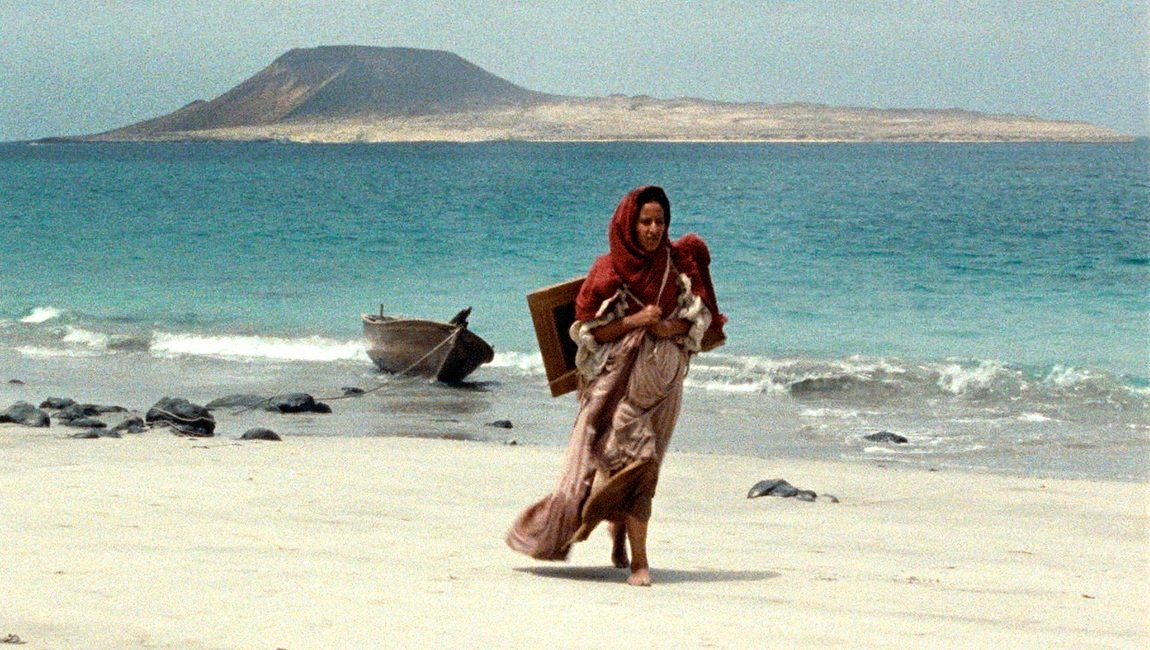
Helena Girón and Samuel Delgado’s The Fortunate Isles begins with images of gently undulating water accompanied by a brief text providing historical context for their story: “In the 15th century, the eastern Canary Islands were conquered by Norman navigators in the service of the Crown of Castile. After devastating the indigenous population, the settlers brought slaves from the nearby coasts of Africa as well as people from Castile, who believed they were heading towards prosperous lands.” A slow, somber montage of landscape shots quickly follows, immediately dispelling any notions of potential prosperity. This is a dry, desolate terrain, with beaches of stone and dark silt and stalks of wispy, yellowed grass. Small, single-room shacks are jammed into crevices, people’s meager belongings covered in dust. Onto this desolate land enters Fátima (Luisa Ahl Laabiad), a young, very pregnant woman who is the property of the decrepit Gaspar (Lou Castel), a blind, alcoholic Marquise who owns this small chunk of mostly useless island.
Continuing with the formal and political concerns of their first feature-length film, 2021’s They Carried Death, Girón and Delgado eschew traditional narrative exposition in favor of a stripped-down, elliptical series of vignettes; what follows is a brief but potent exploration of a colonized land destroying the poor souls dragged there against their will. Gaspar controls the only water well on the island, which he has Fátima parcel out to the other denizens (it’s unclear if they too are slaves or serfs, although their dire circumstances remain the same regardless). They are all dirty and unkempt, imploring her for more water and food, but she refuses. Gaspar fears that if they take too much, then the well will run dry; and besides, he has no real interest in the well-being of these people. A man ferries goods to the island, but when Fátima asks him to bring water and food, he replies that the Marquise requests only wine. We see the people trying to fish, mending nets, and praying for rain, while Gaspar lounges in a chair and demands Fátima describe what he cannot see. The novelty of a mirror washing up on shore provides a brief moment of intrigue during an otherwise monotonous routine, but of course Gaspar quickly claims it to hang on his own wall. He’s almost entirely an invalid, but has the serene countenance of a despicable man who is sure of his place in the world, and even as Fátima bathes and cleans him, Gaspar is quick to correct her French and chuckle at her halting, stumbling accent. He’s a stubborn fool, in other words, and is involved in a long-standing feud with his adult son who owns the land across the channel (played by one-time Claire Denis regular Grégoire Colin). Unsurprisingly, it is Gaspar’s stubbornness that will ultimately doom him and his people.
The Fortunate Isles can’t help but bring to mind Rossellini’s Stromboli and Costa’s Casa de Lava. Like those films, The Fortunate Isles takes a heavily symbolic central idea — the well of colonialism has dried up as the land rejects the occupier — and renders it in firm, physical ways. The landscape is both a hard, material reality and a psychological space, existing as an uncaring, unblinking witness to the human drama playing out upon it. The filmmakers convey a lot with very little; at barely 80 minutes long, The Fortunate Isles is compact but heavy with ideas. Much of the film is shot in medium close-up, except for when characters are juxtaposed against the landscape, emphasizing their smallness. Interiors are cramped and claustrophobic, but the vastness of the outdoors represents only another kind of imprisonment. The marquise does eventually die, and it’s here that the film complicates its scenario. The villagers plunder the well and devour the marquis’ chicken coup, but once their revelries have ended, they find that the well has indeed run dry. For her part, Fátima presents a complicated case; despite the branded scar on her face, she is cleaner and more put together than the others, and it’s strongly suggested that she might have enjoyed her station above the other villagers. She is, of course, deeply concerned about the well-being of her unborn child, and guards a secret supply of water even when others demand help for their own newborn baby. It’s a complicated moral quandary, one which the filmmakers refuse to shy away from. Fátima is a victim, certainly, but also perpetuates some of the same behaviors as her colonial oppressors. A long sequence of desperate people drinking seawater is deeply disturbing, and while some of the men take a boat out to catch up to a distant storm to collect rainwater, it’s just as likely that they will face death. It all builds to a stunning conclusion, one which could be read as a genuine miracle or simply as a cruel vicissitude of fate. What’s certain is that colonial violence renders its victims helpless against either.
Published as part of TIFF 2026 — Dispatch 4.
Comments are closed.