
The dovetailing of a post-Free Solo film landscape with the advent of a mass production, streaming-focused documentary apparatus — exacerbated by the home-viewing requirements and trends of early Covid — has resulted in the homogenization of what was once one of cinema’s most adventurous forms (and quite literally when it comes to adventure docs). Even looking beyond the milquetoast, ready-made genre templates that have been stamped, approved, and nigh-mandated for true crime and nature documentaries that hit streaming platforms with the regularity of the well-fibered, there is a scarcity of quality nonfiction cinema accessible to viewers. This is due both to top-down profitability decisions operating in an ouroboros feedback loop tandem with consumers and to the industry’s writ large capitulation to our digital era’s preference for sensationalism, subsumed into the presentation and construction of even the most ostensibly serious-minded material. It’s depressing enough that Trump the Redux has ushered in a wave of overearnest but deceptively lightweight documentaries — ones that function only to reinforce the status quo by keeping attention trained on systemically-engineered cultural ills, allowing a neoliberal audience to gorge themselves on their own decency, all from the comfort of their sofas and sectionals. But now we are forced to suffer a form that has abandoned its roots in the avant-garde in favor of all the visual panache of a Zoom call; it’s to the point that your average documentary can only be dubiously regarded as a visual medium anymore.
And so, whatever prefab designs engender their creation, there is at least a concrete visualism to nature docs — and all tendrils of subgenre that umbrella term implies — that passes a baseline sniff test for cinematic form. One particular branch in the realm, growing in popularity in the wake of the aforementioned Free Solo, is the one that aims to paint psychological portraiture of the cortisol-depleted, highlighting those individuals inclined to testing human limits on the extreme surfaces and facades of the natural world. It’s a film flavor no less indebted to our taste for the sensational and still very much amenable to the favored talking head format of conveyor-belt cinema, but one which also allows kinetic, even experimental, formalism, intentional compositions, and insight from the minds of those who we can usually safely suspect might also find fault with the kind of mass media consumption documentaries now too often reflect. Into this tradition comes Mila Aung-Thwin’s The Ultra Runner, which purports to detail twinned past-and present narratives: of ultramarathoner Tiberiu Uşeriu and his participation in 2017’s 6633 Arctic Ultra, a punishing 380-mile footrace through subzero Yukon territory; and re-enactments of the athlete’s childhood in Romania, which was plagued by familial disruption and abuse, resulting in a decade-long prison sentence earlier in this life.
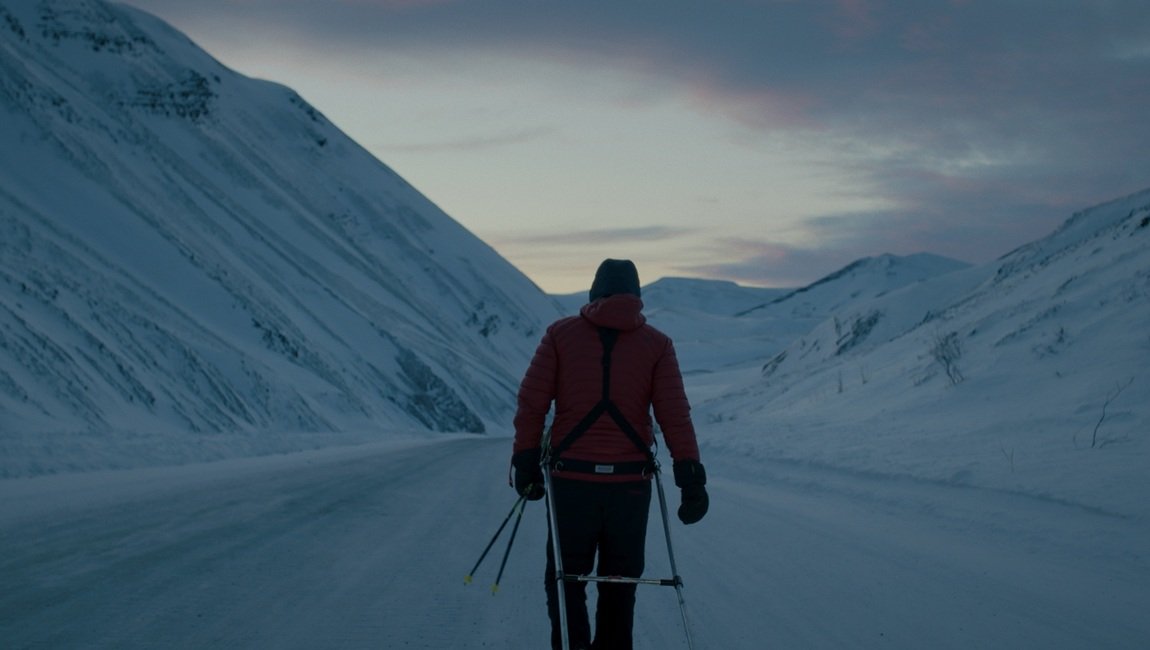
That innate drama to The Ultra Runner’s narrative offers a compelling enough setup for a documentary of this sort, and there is a fitting austerity to the film’s depiction of an endeavor so grueling on both mind and body; to inject undue fanfare and tension into the presentation of a race so brutal that it sometimes fields fewer than 15 participants would cultivate a fatal dissonance here. Similarly, the material world that is captured during this race is far from the grandiosity of spacebound mountaintops or the dark depths of an alien ocean world, instead consisting mostly of windswept snowy highways and passerby longhaulers. Indeed, the best footage to be found is decidedly humble, as when a disembodied voice from behind the camera, falling into the athlete’s pace, fails to elicit any response from Uşeriu, who is presumably locked into the kind of psychological empyrean necessary to accomplish such a feat. It’s tough to imagine a tougher mystery to solve than that of a man who can achieve something like this, and simply observing the act establishes a fascinating record.
Unfortunately, The Ultra Runner’s other half, detailing Uşeriu’s difficult life journey as a companion piece to that of the race’s difficulty, doesn’t get much more complex than that conceptual contrast. It’s a shame, too, because in the film’s gentler moments the endurance athlete offers fascinating glimpses into a complex person worthy of an expanded canvas. Instead, Aung-Thwin keeps things as blandly inspirational as possible — to the point of highlighting Uşeriu’s present-day motivational-speaking work multiple times — flattening psychological nuance into easily digestible eat-pray-love gruel absent any real interrogation. The director employs the same biopic template as fiction films, falling prey to the pattern of reducing life to a montage of the biggest dramatic beats, which has the effect of lending everything the sheen of the manufactured. And none of this is helped by Aung-Thwin’s formal approach to his re-enactments of the past, which possess a halcyon, sun-dappled visual quality and a self-conscious sheen of melancholic yesteryear. Not only does this leave one half of the film to feel in direct conflict with the other, but it distractingly emphasizes the self-conscious artifice of the narrative’s structure, leaving it to exist at an awkward nexus of fairy tale impressionism and realist tragedy. That’s not to deny the genuine vein of moving humanism that runs throughout the film, but to observe that much in the way that motivational speaking becomes a bumper-sticker testament to real human experience, The Ultra Runner opts to employ platitude and narrative convenience at the expense of a less pat, more honest reflection of life.
Published as part of TIFF 2026 — Dispatch 5.
Comments are closed.