
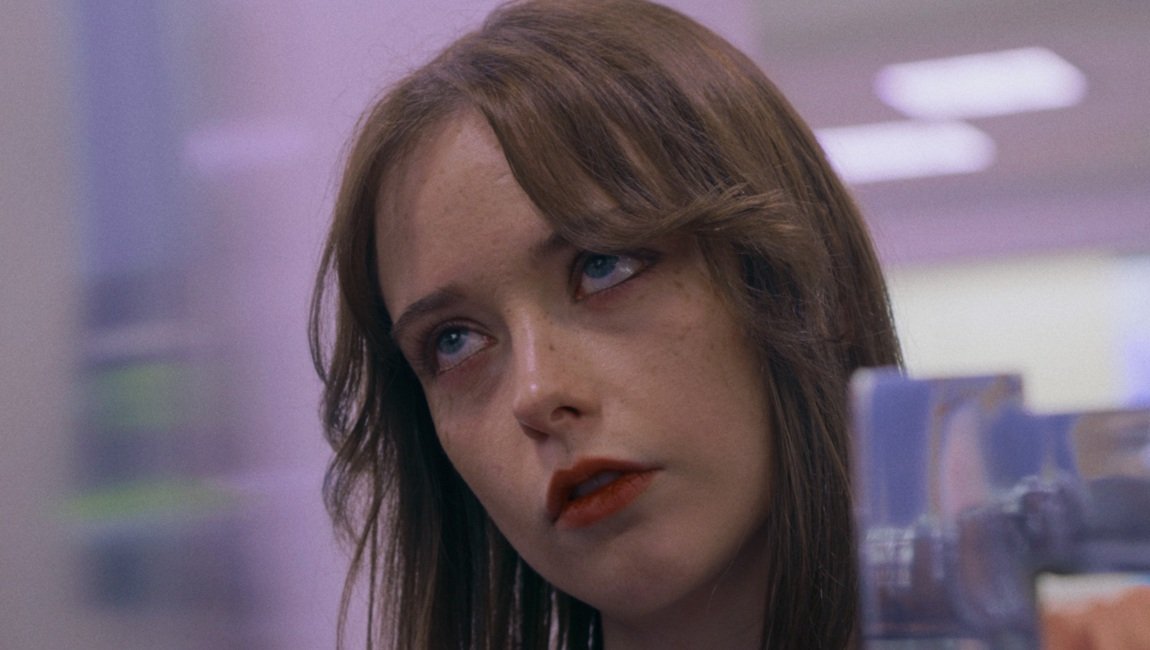
There are exactly two minutes and 39 seconds in which Harrison Atkins’ second feature operates as a straightforward slice of ineffectual mumblecore. We follow our primary protagonist, the glum, John Denver-looking Ricky (David Brown), and his pal Tepper (Chase Williamson) as they wander down a suburban street, shopping in hand, trading small talk about their respective directionless lives and the last dregs of their artistic ambitions. Then they round a corner, and there are six men, prone, licking at the asphalt like libidinous human geckos. The sight seems to upturn something in Ricky, his ambling existence suddenly capsized by a fragmenting sense of time and space. As he tries to understand what is happening, he meets Aura (Suzanna Son), someone who seems to have fallen into a similar alternative world, and the pair attempt to make sense of their increasingly confused reality.
The world is far from short on films in which people scramble to find the truth in L.A.’s vast and baffling labyrinth, but Atkins’ sense of style sets it apart from many of its more straitlaced contemporaries. The camera spends much of its time in a sickly leer, off-balance, either too far away or too close to the action for comfort. When coupled with the Sour Minnows’ increasingly (and wilfully) baffling plot, it doesn’t just evoke paranoia but rather evokes paranoia about feeling paranoid, and fills familiar landscapes and characters with a very real, clammy tension. Even in the film’s most low-key moments, its malls, crummy apartments, and parking lots take on a strange, looming sense of fearfulness, and it means Atkins’ film never lags, even when it occasionally struggles to corral its tangents.
Now, it would be foolish not to mention the elephant in the room of an L.A.-set, nightmare-logic mystery of Hollywood’s dark side, particularly when the elephant has a quiff, a unique, reedy voice, and is named David Lynch. Sour Minnows is clearly operating in the shadow of both Mulholland Drive and Inland Empire, and not in the sense of only a passing comparison either. Beyond the similar premise and a preoccupation with doors to other realities, the film’s whole tone of incomprehensible yet all-consuming dread is one that Lynch mastered and one that Atkins very readily pursues. It’s perhaps an unkind comparison to make as it, as the Lynch tag does with much of the American indie cinema that worships at his altar, shines a light on Sour Minnows’ shortcomings. Its characters are ultimately rather thin, and we struggle to warm to them, meaning the film doesn’t cultivate the emotional investment that cuts through Lynch’s post-millennium L.A. work, ultimately dulling its impact a bit. And like Mulholland Drive, one of the film’s central thematic strands is to act as an elegy for the people that Hollywood has and continues to destroy in their pursuit of its dream (the film is dedicated to Jeff Baena); you don’t for a second doubt its sincerity, but its execution also doesn’t engender the same level of rage at the cruelty of the system that Lynch achieves.
However, the film’s dalliances with the Lynchian are evidently at least partly intentional; there’s a shot that wilfully mimics the scene behind Winkies in Mulholland Drive, and Aura’s red slippers tie the film to the Wizard of Oz, Lynch’s self-described blueprint. These references work to shift the film forward, a new, if not entirely radical take on the Hollywood dreamworld mystery. Where Lynch’s Hollywood was colored by film noir and soap opera, Atkins’ is coloured by AI, influencers, and Lynch himself. This sense of exploring a hell that someone else has already mapped adds a strange desperation to the sickly unreality the film carries, as if the incomprehensible nightmare our characters are in is one that spirals through cinematic history itself.
It’s also worth noting that Sour Minnows is a vast improvement on Atkins’ debut, 2015’s comparatively sluggish Lace Crater, and displays evidence of a talented filmmaker, one with a real handle on their visual style and who can channel it into a distinctly unsettling atmosphere. During its heroically brief runtime, Sour Minnows is a consuming descent into our modern maze of hallucinatory confusion, as if it never quite convinces that there’s as much at the center of its labyrinth as you would hope — or find in Lynch. But shoes to fill don’t get much bigger, and Atkins’ sophomore outing nonetheless makes a strong suggestion that something even better is quite likely still to come.
Published as part of New/Next Film Festival 2026 — Dispatch 1.
Comments are closed.