
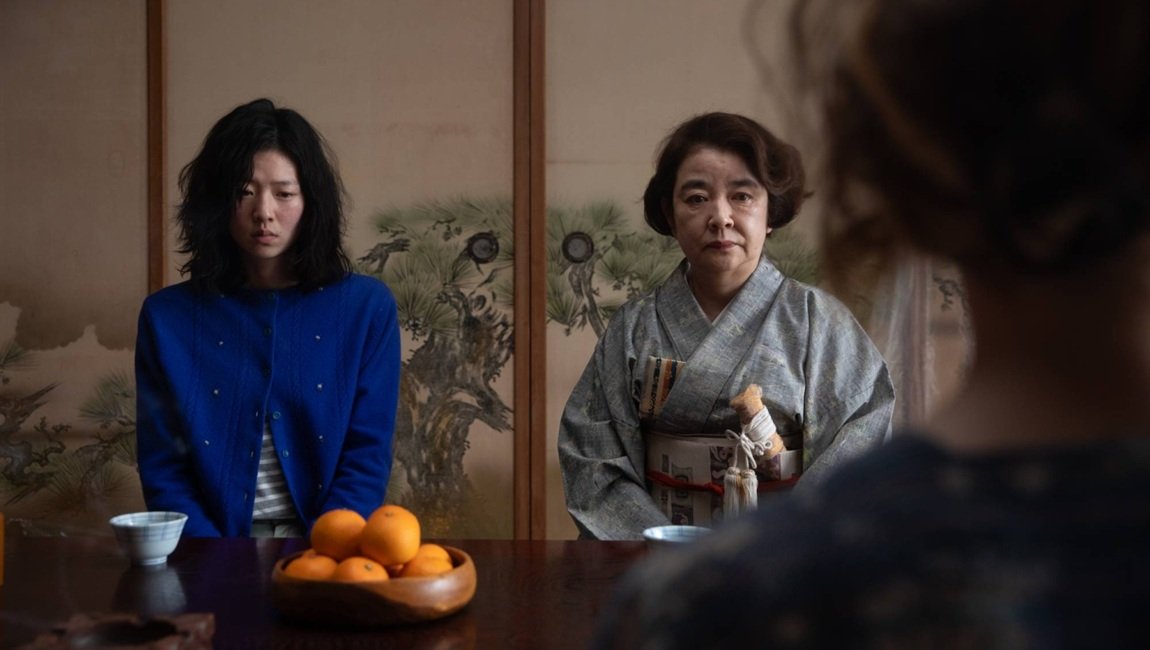
Fujiko (Yuki Katayama) sells insurance to a cook by making her life part of the policy. She looks at her prospective client, adopts a hangdog manner, and begins listing everything that has gone wrong. Director Taichi Kimura then cuts to 1977 as soon as the story gets underway, and Fujiko’s past reaches us as a sales pitch, with all the calculation that entails. She has learned that suffering can close a deal. The joke complicates the film’s evident admiration for her: survival has given Fujiko a story, and she has become very good at finding uses for it.
In Fujiko, the titular character’s account begins with her daughter Mari’s birth during a storm and hospital blackout. Soon afterward, Fujiko’s in-laws take the baby, but the film does not turn this into a custody dispute, as the kidnapping ends any possibility of compromise. With help from her own mother, Fujiko retrieves Mari and leaves. Taking the child back is the first time she claims motherhood for herself; raising Mari alone follows from that break. She does not set out to make an ideological statement, though her refusal to let either family determine how she lives gives the decision an obvious political charge.
Fujiko says she approaches 500 nurseries, nearly all of which reject Mari for being too young. A friend working at one finally gets her a place. Childcare enables Fujiko to work, and work takes almost every hour the nursery has freed for her, with her days narrowing in scope to the act of earning money and then returning to collect Mari. Kimura repeatedly returns to this routine, allowing self-sufficiency to register as tiring well before it becomes triumphant. And while the story begins in 1977, eight years before Japan passed its Equal Employment Opportunity Law, Kimura does not lean on retrospective explanation. Fujiko simply encounters inequality as a timetable she cannot make work.
Light narrates these reversals alongside the screenplay, and Kimura’s camera organizes Fujiko’s world around access to it. When her circumstances deteriorate, interiors sink into shadow and cigarette smoke; better periods are filmed under bare lamps or in direct sun, often outdoors. The alternation is hardly subtle, yet its bluntness belongs to the film’s storybook rhythm — the pattern gives each change in fortune an immediately recognizable look. It can also announce a downturn or recovery before Fujiko understands the material reality of what has changed.
Katayama gives the lighting scheme a less predictable center, adjusting Fujiko’s manner to whoever is listening. The dejected delivery offered to a client is both remembered pain and practiced sales technique; with her family, the same reserve becomes defiance. Katayama does not chart confidence as a steady rise, but instead lets Fujiko harden, showing how endurance can become a temperament. Working for Mari remains an answer to the mother and brother who humiliated her, and even in the film’s brisker work scenes, Katayama retains something of that grievance in her bearing.
Editor Aika Miyake moves through the five years by returning to Fujiko’s insurance clients. A glance across a table and the beginning of another unhappy story open a passage into the past. At first, the cut gives Fujiko control: she chooses where her history starts and how much a customer hears. But soon the structure becomes visible, as Fujiko suffers, recovers, finds work, and turns what happened into another sales anecdote. The speed of this suits Kimura’s music video background, but the repetition can also make the transitions feel mechanical. Each return to the past promises development and delivers another restart.
Fujiko’s professional ascent is built from relationships she is strikingly willing to convert into opportunities. She starts taking her meals at the restaurant run by a friend of her late father. The visits grow into something resembling family, and the old man becomes “Grandpa.” There, she meets the insurance salesman who brings her into the business, and when Fujiko discovers that her history moves clients, soon she is outselling everyone. She also recognizes her colleague’s growing attachment, but does little to interrupt it before he proposes. She considers accepting, provided he move with her, but then a promotion offers Fujiko a new posting, and she is ready to go. The people who fed her when she had nowhere else, along with the man who imagined a future with her, then seem to immediately belong to a chapter she considers finished. Fujiko treats the departure as another brave restart. Fujiko scarcely pauses. Mari voices the cost in plain terms: she wants a father. She never gets one.
The film’s sound design, meanwhile, works against the neatness of its narrative pattern. Its live-recorded rock music has a coarse, provisional quality, as though the musicians were finding the cue while the scene was already running; as a result, guitar and drums push to the front of the mix instead of politely supporting the dialogue. That looseness is of a thematic piece with Fujiko’s tendency to act first and decide what her actions meant afterward, and the record left by Fujiko’s father turns that rough sound into a full stylistic rupture. She wakes to find the disc on the turntable, marked with a dedication. The guitar solo begins, brightness breaks into the image, and rapid animation takes over, the moment seeming closer to a drug trip than appreciation of a family keepsake. The eruption is enjoyable and blunt, yet the authorization still comes from a man. After escaping relatives who presume to decide for her, Fujiko receives her clearest affirmation from her dead father.
Humor keeps the film from demanding sympathy every time Fujiko suffers another setback. The sales framework guarantees that Fujiko survives whatever we are watching, and jokes repeatedly disperse the tension Katayama has begun to build. But by the final stretch, repetition has dulled even her force. So, in 1982, Fujiko has become the mother she was not prepared to be when Mari was born, and Kimura makes that growth credible by grounding it in the daily labor of earning money and finding care for a child. But Fujiko’s capacity to live with other people once she no longer needs their immediate help develops less convincingly — her career advances; her emotional habits keep returning to their starting point. Mari’s wish for a father thus remains unanswered, one part of Fujiko’s history that cannot be polished into a successful sale.
Published as part of NYAFF 2026 — Dispatch 1.
Comments are closed.