
At the small airport in Karatas, Bek (Berik Aitzhanov) arrives dressed for another climate. Greasy hair hangs around his untrimmed beard, and a heavy fur coat covers him despite the semi-arid heat. A shotgun rests at his side. The men sent to receive him search his luggage with the officious gravity of immigration agents and find a copy of Hamlet. The joke is already complete: a criminal outfit has built itself an airport protocol. Bek then notices the silhouette of the woman who arrived with him, raises the gun, and pauses. He recognizes the threat before the story identifies her. His instincts work; deciding what to do with them takes longer.
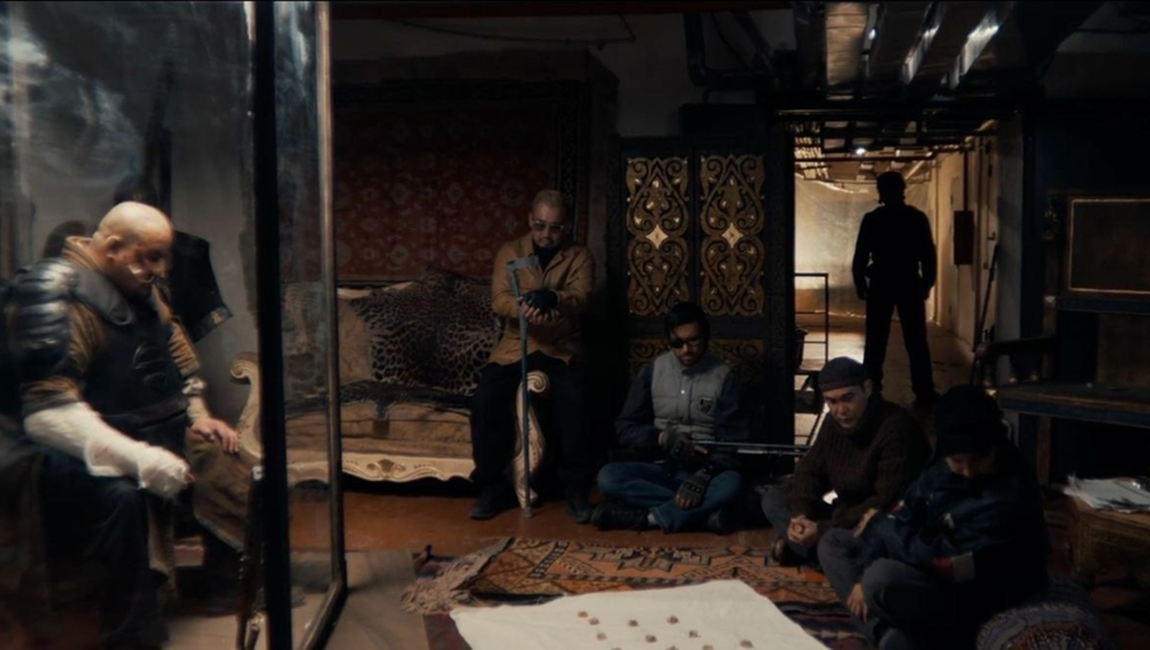
Bek has been hired to protect Baylat (Dias Baituov), a criminal landlord currently seeking public office. Anna Starchenko’s taciturn gunwoman has come to kill him, accompanied everywhere by a silent child. None of this surprises Bek very much. He regards Baylat and his security crew with the irritation of a capable employee discovering that incompetence outranks him. Karatas, director Adilkhan Yerzhanov’s invented province, has always accommodated this sort of arrangement. Goliath tied housing and employment to the gangster terrorizing a community, while Steppenwolf treated violence as the local atmosphere. Turgaud follows the payroll. Baylat calls his coercion security, offers Bek a job administering it, and expects professionalism to settle any moral questions.
Yerzhanov often leaves the camera at a remove and asks Aitzhanov’s face to carry information that dialogue withholds. The actor’s stillness has considerable weight: disgust appears, recedes, and is replaced by the tired calculation of a man accustomed to serving people he despises. For a while, Bek’s delays give ordinary professional gestures an uneasy second meaning. Across 124 minutes, however, the device grows burdensome. Some scenes acquire a peculiar tension from waiting for him to act. Others seem to be waiting for the screenplay to catch up. A protagonist uncertain about action need not make for an inert film, but Turgaud too often treats duration as if it were the same thing as thought.
The comedy is sharpest when Bek’s competence spoils the rhythm of the action movie around him. He insists that Baylat needs armored transport, irritating the existing head of security and prompting a challenge. The resulting fight barely qualifies as one. Men swing; Bek slips aside; his attackers tumble with the delayed timing of slapstick. Then he picks up a dombra, the Kazakh two-stringed lute, and plucks a single sour note as the scuffle gathers speed. He supplies his own defective action score. The joke is beautifully stupid, stripping the confrontation of its masculine ceremony while still allowing Bek to dominate it. Yerzhanov displaces the expected impact into dodges, pauses, and that stubborn note. This is genre as an old routine whose participants can no longer summon much conviction.
Competence still ties Bek to Baylat more securely than loyalty would. After discovering that the former security chief plotted to kill their employer, Bek promises that the man’s family will be spared if he surrenders. The man accepts. Baylat ignores the agreement and orders his own son to beat the family, their heads covered by bread sacks. The boy attacks with delighted abandon. Bek’s word, which he imagined as a private reserve of honor, turns out to belong to his employer too. The sequence leaves little room for heroic misunderstanding. Protection means keeping Baylat alive long enough for him to violate other people’s promises, and the violence is already being passed down as a form of amusement.
Turgaud frequently accompanies brutality with sardonic voiceover or music that treats the bloodshed as a joke. The resemblance to Tarantino lies in the use of tonal incongruity to loosen the bond between impact and consequence, though Yerzhanov offers little of Tarantino’s seductive chatter or choreographic pleasure. His thugs are usually too shabby to become glamorous. At its best, the humor catches aggression exceeding the intelligence of those responsible for it. The casting session, where a man apparently earns his place in the crew because he can dance flamenco, works through sheer administrative nonsense. Elsewhere, the winking accompaniment becomes predictable. As bodies accumulate, the viewer’s detachment begins to resemble the indifference the film attributes to Karatas. Cynicism becomes one more cue on the soundtrack.
Bek supplies the usual fatalist defense. If the gunwoman kills Baylat, he argues, another man will occupy the vacancy, perhaps someone worse. She allows for the possibility that the next man might be better. The exchange is simple, almost schematic, but it puts pressure on Bek’s pose of weary knowledge. His pessimism has the convenience of a work rule: if power never changes, he never has to choose whom his skill serves. The child’s persistent presence makes that argument harder to shrug off, though Yerzhanov gives the figure no dialogue and little independent identity. The film seems to want the child in the moral geometry of each confrontation without deciding whether that presence amounts to witness, vulnerability, or hope. That uncertainty is preferable to forcing a national allegory onto the character, but it also leaves Starchenko’s gunwoman carrying an underwritten symbolic burden.
Later, Bek sits beneath colored light cast through an image of saints and asks forgiveness. The scene removes ignorance as a possible alibi. He knows where he is and what his labor enables; what he lacks is a tolerable way to stop. His last-minute decision to change sides, followed by his willingness to surrender himself to death, carries the outline of redemption, though relief may be the stronger feeling. By abandoning his assignment, he finally makes a choice that cannot be translated into professional duty. It is also a compact resolution to a conflict that the film’s long stretches of contemplation have circled more often than deepened.
There is pleasure in Turgaud’s scuffed grandeur, especially when Baylat’s miniature regime appears monstrous and embarrassingly amateur. Yerzhanov remains alert to the comedy of men using genre poses to disguise the pettiness of their authority. Yet an action film that continually postpones action must make the waiting exert pressure of its own. Here it sometimes produces only vacancy, with another unreadable glance asked to hold the narrative together. Bek’s eventual refusal preserves a battered sense of justice in Karatas, but Turgaud only reaches it after too much waiting for his face to decide what the rest of the movie has already shown.
Published as part of NYAFF 2026 — Dispatch 1.
Comments are closed.